7. The TIMES Climate Module
This chapter provides a detailed description of the theoretical approach taken to model changes in atmospheric greenhouse gas concentrations, radiative forcing, and global mean temperatures in the TIMES Climate Module. Appendix A of Part II contains a full description of the implementation of the Climate Module in TIMES, including parameters, variables, and equations, as represented in the TIMES code.
The Climate Module starts from global emissions of CO2, CH4, and N2O, as generated by the TIMES global model, and proceeds to compute successively:
the changes in CO2, CH4, and N2O concentrations via three separate sets of equations;
the total change (over pre-industrial times) in atmospheric radiative forcing resulting from the three gases plus an exogenously specified additional forcing resulting from other causes (other anthropogenic and/or natural causes, as defined by the user), and
the temperature changes (over pre-industrial times) in two reservoirs (surface and deep ocean).
The climate equations used to perform these calculations were adapted from Nordhaus and Boyer (1999), who proposed a three reservoir model for the CO2 cycle only[32]. This leads to linear recursive equations for calculating CO2 concentrations in each reservoir. The temperature equations use a two-reservoir model leading also to linear equations. The forcing equation is the one used in most climate models, and is non-linear.
In TIMES, we have modeled separately the life cycles of two other GHG’s besides CO2, namely methane and nitrous oxide. These linear equations give results that are good approximations of those obtained from more complex climate models (Drouet et al., 2004; Nordhaus and Boyer, 1999).
The non-linear radiative forcing equation used in virtually all climate models was replaced in TIMES by a linear approximation whose values closely approach the exact ones as long as the useful range is carefully selected. This was done in order to keep the entire model linear, and therefore to allow the user to set constraints on forcing and on temperature as well as on concentrations and on emissions.
The temperature equations have been kept as in Nordhaus and Boyer.
We now describe the mathematical equations used at each of the three steps of the climate module.
7.1. Concentrations (accumulation of CO2, CH4, N2O[33])
a) CO2 accumulation is represented as the linear three-reservoir model below: the atmosphere, the quickly mixing upper ocean + biosphere, and the deep ocean. CO2 flows in both directions between adjacent reservoirs. The 3-reservoir model is represented by the following 3 equations when the step of the recursion is equal to one year:
with
\(M_{atm}(y)\), \(M_{up}(y)\), \(M_{lo}(y)\): Concentration (expressed in mass units) of CO2 in atmosphere, in a quickly mixing reservoir representing the upper level of the ocean and the biosphere, and in deep oceans (GtC), respectively, in year y (GtC)
\(E(y) = CO_2\) emissions in year \(y\) (GtC)
\(\phi_{i,j}\), transport rate from reservoir \(i\) to reservoir \(j\) (\(i\), \(j\) = \(atm\), \(up\), \(lo\)) from year \(y-1\) to \(y\)
b) CH4 accumulation is represented by a so-called single-box model in which the atmospheric methane concentration obeys the following equations assuming a constant annual decay rate of the anthropogenic concentrations \(\Phi_{CH_4}\) (whereas the natural concentration is assumed in equilibrium):
where
\(CH4_{atm}\), \(CH4_{up}\), \(CH4_{tot}\), and \(EA_{CH_4}\) are respectively: the anthropogenic atmospheric concentration, the natural atmospheric concentration[34], the total atmospheric concentration (all three expressed in \(Mt\)), and the anthropogenic emission of CH4 (expressed in \(Mt/yr\)). The anthropogenic emissions \(EA_{CH_4}\) are generated within the model and enter the dynamic equation (7.4) in order to derive the anthropogenic concentration. Note that the natural concentration \(CH4_{up}\) is constant at all times. (See initial values for these and other parameters in Part II, Appendix A.)
\(CH4_{tot}\) is then reported and used in the forcing equations. All quantities are indexed by year.
\(1 - \Phi_{CH_4}\) is the one-year retention rate of CH4 in the atmosphere.
\(d_{CH_4} = 2.84\) (the density of CH4, expressed in \(Mt/ppbv\)) is then used to convert concentration in \(Mt\) into \(ppbv\) for reporting purposes.
c) N2O accumulation is also represented by a single-box model in a manner entirely similar to CH4, although with different parameter values. The corresponding equations are as follows:
7.2. Radiative forcing
We assume, as is routinely done in atmospheric science, that the atmospheric radiative forcings caused by the various gases are additive (IPCC, 2007). Thus:
We now explain these four terms.
a) The relationship between CO2 accumulation and increased radiative forcing, \(∆F_{CO_2}(y)\), is derived from empirical measurements and climate models (IPCC 2001 and 2007).
where:
\(M_0\) (i.e., CO2ATM_PRE_IND) is the pre-industrial (circa 1750) reference atmospheric concentration of CO2 = 596.4 GtC
\(\gamma\) is the radiative forcing sensitivity to atmospheric CO2 concentration doubling = \(3.7 \ W/m^2\)
b) The radiative forcing due to atmospheric CH4 is given by the following expression (IPCC 2007), where the subscript tot has been omitted
c) The radiative forcing due to atmospheric N2O is given by the following expression (IPCC, 2007)
where:
Note that the \(f(x,y)\) function, which quantifies the cross-effects on forcing of the presence in the atmosphere of both gases (CH4 and N2O), is not quite symmetrical in the two gases. As usual, the \(0\) subscript indicates the pre-industrial times (1750).
d) \(EXOFOR(y)\) is the increase in total radiative forcing at period t relative to pre-industrial level due to GHG’s that are not represented explicitly in the model. Units = \(W/m^2\). In Nordhaus and Boyer (1999), only emissions of CO2 were explicitly modeled, and therefore \(EXOFOR(y)\) accounted for all other GHG’s. In TIMES, N2O and CH4 are fully accounted for, but some other substances are not (e.g. CFC’s, aerosols, ozone, volcanic activity, etc.). Therefore, the values for \(EXOFOR(y)\) will differ from those in Nordhaus and Boyer (1999). It is the modeler’s responsibility to include in the calculation of \(EXOFOR(y)\) the forcing from only those gases and other causes that are not modeled. The careful modeler may also want to adapt the \(EXOFOR\) trajectory to particular scenarios. This has been done using alternative trajectories for \(EXOFOR\) provided by other models, as was done in a multi-model, multi-scenario study conducted at the Energy Modeling Forum (Clarke et al., 2009)
The parameterization of the three forcing equations ((7.8), (7.9), and (7.10)) is not controversial and relies on the results reported by Working Group I of the IPCC. IPCC (2001, Table 6.2, p.358) provides a value of 3.7 for \(γ\), smaller than the one used by Nordhaus and Boyer (\(γ = 4.1\)). We have adopted this lower value of 3.7 \(W/m^2\) as default in TIMES. Users are free to experiment with other values of the γ parameter. The same reference provides the entire expressions for all three forcing equations.
7.3. Linear approximations of the three forcings
In TIMES, each of the three forcing expressions is replaced by a linear approximation, in order to preserve linearity of the entire model. All three forcing expressions are concave functions. Therefore, two linear approximations are obvious candidates. The first one is an approximation from below, consisting of the chord of the graph between two selected end-points. The second one has the same slope as the chord and is tangent to the graph, thus approximating the function from above. The final approximation is the arithmetic average of the two approximations. These linear expressions are easily derived once a range of interest is defined by the user.
As an example, we derive below the linear approximation for the CO2 forcing expression. The other approximations are obtained in a similar manner.
Linear approximation for the CO2 forcing expression (see technical note “TIMES Climate Module” for similar approximations of the other two forcings):
First, an interval of interest for the concentration M must be selected by the user. The interval should be wide enough to accommodate the anticipated values of the concentrations, but not so wide as to make the approximation inaccurate. We denote the interval (\(M_1\),\(M_2\)).
Next, the linear forcing equation is taken as the half sum of two linear expressions, which respectively underestimate and overestimate the exact forcing value. The underestimate consists of the chord of the logarithmic curve, whereas the overestimate consists of the tangent to the logarithmic curve that is parallel to the chord. These two estimates are illustrated in Fig. 7.1, where the interval (\(M_1\),\(M_2\)) is from 375 ppm to 550 ppm.
By denoting the pre-industrial concentration level as \(M_0\), the general formulas for the two estimates are as follows:
Overestimate:
Underestimate:
where: \(slope = \gamma \times \frac{\ln(M_{2}/M_{1})/\ln 2}{(M_{2} - M_{1})}\)
Final approximation:
7.4. Temperature increase
In the TIMES Climate Module as in many other integrated models, climate change is represented by the global mean surface temperature. The idea behind the two-reservoir model is that a higher radiative forcing warms the atmospheric layer, which then quickly warms the upper ocean. In this model, the atmosphere and upper ocean form a single layer, which slowly warms the second layer consisting of the deep ocean.
with
\(ΔT_{up}\) globally averaged surface temperature increase above pre-industrial level,
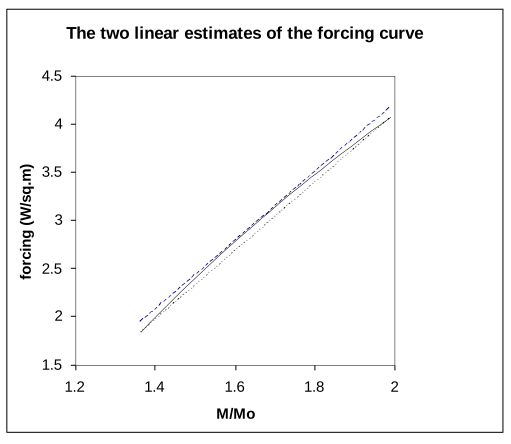
Fig. 7.1 Illustration of the linearization of the CO2 radiative forcing function.
\(ΔT_{low}\) deep-ocean temperature increase above pre-industrial level,
\(σ_1\) 1-year speed of adjustment parameter for atmospheric temperature (also known as the lag parameter),
\(σ_2\) coefficient of heat loss from atmosphere to deep oceans,
\(σ_3\) 1-year coefficient of heat gain by deep oceans,
\(λ\) feedback parameter (climatic retroaction). It is customary to write \(λ\) as \(λ =γ/C_s\), \(C_s\) being the climate sensitivity parameter, defined as the change in equilibrium atmospheric temperature induced by a doubling of CO2 concentration. In contrast with most other parameters, the value of \(C_s\) is highly uncertain, with a possible range of values from \(1^oC\) to \(10^oC\). This parameter is therefore a prime candidate for sensitivity analysis, or for treatment by probabilistic methods such as stochastic programming.
For more details on the implementation of the Climate Module in TIMES, including parameters, variables, and equations, as represented in the TIMES code, see Appendix A of Part II.