3. Parameters
While sets describe structural information of the energy system or qualitative characteristics of its entities (e.g. processes or commodities), parameters contain numerical information. Examples of parameters are the import price of an energy carrier or the investment cost of a technology. Most parameters are time-series where a value is provided (or interpolated) for each year (\(datayear\)). The TIMES model generator distinguishes between user input parameters and internal parameters. The former are provided by the modeller (usually by way of a data handling system or “shell” such a VEDA-FE or ANSWER-TIMES), while the latter are internally derived from the user input parameters, in combination with information given by sets, in order to calculate for example the cost coefficients in the objective function. This Chapter first covers the user input parameters in Section 3.1 and then describes the most important internal parameters as far as they are relevant for the basic understanding of the equations (Section 3.2). Section 3.3 presents the parameters used for reporting the results of a model run.
3.1. User input parameters
This section provides an overview of the user input parameters that are available in TIMES to describe the energy system. Before presenting the various parameters in detail in Section 3.1.3 two preprocessing algorithms applied to the user input data are presented, namely the inter-/extrapolation and the inheritance/aggregation routines. User input parameters that are time-dependent can be provided by the user for those years for which statistical information or future projections are available, and the inter-/extrapolation routine described in Section 3.1.1 used to adjust the input data to the years required for the model run. Timeslice dependent parameters do not have to be provided on the timelice level of a process, commodity or commodity flow. Instead the so-called inheritance/aggregation routine described in Section 3.1.2 assigns the input data from the user provided timeslice level to the appropriate timeslice level as necessary.
3.1.1. Inter- and extrapolation of user input parameters
Time-dependent user input parameters are specified for specific years, the so-called data years (\(datayear\)). These data years do not have to coincide with the model years (\(v\) or \(modelyear\)) needed for the current run. Reasons for differences between these two sets are for example that the period definition for the model has been altered after having provided the initial set of input data leading to different milestone years (\(t\) or \(milestoneyr\)) or that data are only available for certain years that do not match the model years. In order to avoid burdening the user with the cumbersome adjustment of the input data to the model years, an inter-/extrapolation (I/E) routine is embedded in the TIMES model generator. The inter-/extrapolation routine distinguishes between a default inter-/extrapolation that is automatically applied to the input data and an enhanced user-controlled inter-/extrapolation that allows the user to specify an inter-/extrapolation rule for each time-series explicitly. Independent of the default or user-controlled I/E options, TIMES inter-/extrapolates (using the standard algorithm) all cost parameters in the objective function to the individual years of the model as part of calculating the annual cost details (see section 3.1.1.3 below).
The possibility of controlling interpolation on a time-series basis improves the independence between the years found in the primary database and the data actually used in the individual runs of a TIMES model. In this way the model is made more flexible with respect to running scenarios with arbitrary model years and period lengths, while using basically the very same input database.
3.1.1.1. Inter/extrapolation options
The TIMES interpolation/extrapolation facility provides both a default I/E method for all time-series parameters, and options for the user to control the interpolation and extrapolation of each individual time series (Table 3.1). The option 0 does not change the default behavior. The specific options that correspond to the default methods are 3 (the standard default) and 10 (alternative default method for bounds and RHS parameters).
Non-default interpolation/extrapolation can be requested for any parameter by providing an additional instance of the parameter with an indicator in the \(YEAR\) index and a value corresponding to one of the integer-valued Option Codes (see Table 3.1 and example below). This control specification activates the interpolation/extrapolation rule for the time series, and is distinguished from actual time-series data by providing a special control label (’0’) in the \(YEAR\) index. The particular interpolation rule to apply is a function of the Option Code assigned to the control record for the parameter. Note that for log-linear interpolation the Option Code indicates the year from which the interpolation is switched from standard to log-linear mode. TIMES user shell(s) will provide mechanisms for imbedding the control label and setting the Option Code through easily understandable selections from a user-friendly drop-down list, making the specification simple and transparent to the user.
The enhanced interpolation/extrapolation facility provides the user with the following options to control the interpolation and extrapolation of each individual time series:
Interpolation and extrapolation of data in the default way as predefined in TIMES. This option does not require any explicit action from the user.
No interpolation or extrapolation of data (only valid for non-cost parameters).
Interpolation between data points but no extrapolation (useful for many bounds). See option codes 1 and 11 in Table 3.1 below.
Interpolation between data points entered, and filling-in all points outside the interpolation window with the EPS (zero) value. This can useful for e.g. the RHS of equality-type user constraints, or bounds on future investment in a particular instance of a technology. See option codes 2 and 12 in Table 3.1 below.
Forced interpolation and extrapolation throughout the time horizon. Can be useful for parameters that are by default not interpolated. See option codes 3, 4, and 5 as well as 14 and 15 in Table 3.1 below.
Log-linear interpolation beyond a specified data year, and both forward and backward extrapolation outside the interpolation window. Log-linear interpolation is guided by relative coefficients of annual change instead of absolute data values.
Option code |
Action |
Applies to |
|---|---|---|
0 (or none) |
Interpolation and extrapolation of data in the default way as predefined in TIMES (see below) |
All |
<0 |
No interpolation or extrapolation of data (only valid for non-cost parameters). |
All |
1 |
Interpolation between data points but no extrapolation. |
All |
2 |
Interpolation between data points entered, and filling-in all points outside the interpolation window with the EPS value. |
All |
3 |
Forced interpolation and both forward and backward extrapolation throughout the time horizon. |
All |
4 |
Interpolation and backward extrapolation |
All |
5 |
Interpolation and forward extrapolation |
All |
10 |
Migrated interpolation/extrapolation within periods |
Bounds, RHS |
11 |
Interpolation migrated at end-points, no extrapolation |
Bounds, RHS |
12 |
Interpolation migrated at ends, extrapolation with EPS |
Bounds, RHS |
14 |
Interpolation migrated at end, backward extrapolation |
Bounds, RHS |
15 |
Interpolation migrated at start, forward extrapolation |
Bounds, RHS |
YEAR (≥1000) |
Log-linear interpolation beyond the specified YEAR, and both forward and backward extrapolation outside the interpolation window. |
All |
Migration means that data points are interpolated and extrapolated within each period but not across periods. This method thus migrates any data point specified for other than \(milestoneyr\) year to the corresponding \(milestoneyr\) year within the period, so that it will be effective in that period.
Log-linear interpolation means that the values in the data series are interpreted as coefficients of annual change beyond a given \(YEAR\). The \(YEAR\) can be any year, including model years. The user only has to take care that the data values in the data series correspond to the interpretation given to them when using the log-linear option. For simplicity, however, the first data point is always interpreted as an absolute value, because log-linear interpolation requires at least one absolute data point to start with.
3.1.1.2. Default inter/extrapolation
The standard default method of inter-/extrapolation corresponds to the option 3, which interpolates linearly between data points, while it extrapolates the first/last data point constantly backward/forward. This method, full interpolation and extrapolation, is by default applied to most TIMES time series parameters. However, the parameters listed in Table 3.2 are by default NOT inter/extrapolated in this way, but have a different default method.
3.1.1.3. Interpolation of cost parameters
As a general rule, all cost parameters in TIMES are densely interpolated and extrapolated. This means that the parameters will have a value for every single year within the range of years they apply, and the changes in costs over years will thus be accurately taken into account in the objective function. The user can use the interpolation options 1–5 for even cost parameters. Whenever an option is specified for a cost parameter, it will be first sparsely interpolated/extrapolated according to the user option over the union of modelyear and datayear, and any remaining empty data points are filled with the EPS value. The EPS values will ensure that despite the subsequent dense interpolation the effect of user option will be preserved to the extent possible. However, one should note that due to dense interpolation, the effects of the user options will inevitably be smoothed.
3.1.1.4. Examples of using I/E options
Example 1:
Assume that we have three normal data points in a FLO_SHAR data series:
FLO_SHAR('REG','1995','PRC1','COAL','IN_PRC1','ANNUAL','UP') = 0.25;
FLO_SHAR('REG','2010','PRC1','COAL','IN_PRC1','ANNUAL','UP') = 0.12;
FLO_SHAR('REG','2020','PRC1','COAL','IN_PRC1','ANNUAL','UP') = 0.05;
\(FLO\_SHAR\) is by default NOT interpolated or extrapolated in TIMES. To force interpolation/extrapolation of the \(FLO\_SHAR\) parameter the following control option for this data series should be added:
FLO_SHAR('REG','0','PRC1','COAL','IN_PRC1','ANNUAL','UP') = 3;
Parameter |
Justification |
Default I/E |
|---|---|---|
ACT_BND
|
Bound may be intended at specific periods only. |
10 (migration) |
PRC_MARK |
Constraint may be intended at specific periods only |
11 |
PRC_RESID |
Residual capacity usually intended to be only interpolated |
1* |
UC_RHST
|
User constraint may be intended for specific periods only |
10 (migration) |
NCAP_AFM
|
Interpolation meaningless for these parameters (parameter value is a discrete number indicating which MULTI curve should be used). |
10 (migration) |
COM_ELASTX
|
Interpolation meaningless for these parameters (parameter value is a discrete number indicating which SHAPE curve should be used). |
10 (migration) |
NCAP_PASTI |
Parameter describes past investment for a single vintage year. |
none |
NCAP_PASTY |
Parameter describes number of years over which to distribute past investments. |
none |
CM_MAXC |
Bound may be intended at specific years only |
none |
PEAKDA_BL |
Blending parameters at the moment not interpolated |
none |
* If only a single \(PRC\_RESID\) value is specified, assumed to decay linearly over \(NCAP\_TLIFE\) years
Example 2:
Assume that we define the following log-linear I/E option for a \(FLO\_SHAR\) data series:
FLO_SHAR('REG','0','PRC1','COAL','IN_PRC1','ANNUAL','UP') = 2005;
This parameter specifies a log-linear control option with the value for the threshold YEAR of log-linear interpolation taken from 2005. The option specifies that all data points up to the year 2005 should be interpreted normally (as absolute data values), but all values beyond that year should be interpreted as coefficients of annual change. By using this interpretation, TIMES will then apply full interpolation and extrapolation to the whole data series. It is the responsibility of the user to ensure that the first data point and all data points up to (and including) the year 2005 represent absolute values of the parameter, and that all subsequent data points represent coefficients of annual change. Using the data of the example above, the first data point beyond 2005 is found for the year 2010, and it has the value of 0.12. The interpretation thus requires that the maximum flow share of COAL in the commodity group IN_PRC1 is actually meant to increase by as much as 12% per annum between the years 1995 and 2010, and by 5% per annum between 2010 and 2020.
3.1.1.5. Applicability
All the enhanced I/E options described above are available for all TIMES timeseries parameters, excluding \(PRC\_RESID\) and \(COM\_BPRICE\). \(PRC\_RESID\) is always interpolated, as if option 1 were used, but is also extrapolated forwards over \(TLIFE\) when either I/E option 5 or 15 is specified. \(COM\_BPRICE\) is not interpolated at all, as it is obtained from the Baseline solution. Moreover, the I/E options are not applicable to the integer-valued parameters related to the \(SHAPE\) and \(MULTI\) tables, which are listed in Table 3.3.
Parameter |
Comment |
|---|---|
NCAP_AFM
|
Parameter value is a discrete numbers indicating which MULTI curve should be used, and not a time series datum. |
COM_ELASTX
|
Parameter value is a discrete number indicating which SHAPE curve should be used, and not a time series datum. |
Nonetheless, a few options are supported also for the extrapolation of the \(MULTI\) and \(SHAPE\) index parameters, as shown in Table 3.4. The extrapolation can be done either only inside the data points provided by the user, or both inside and outside those data points. When using the inside data points option, the index specified for any \(datayear\) is extrapolated to all model years (\(v\)) between that \(datayear\) and the following \(datayear\) for which the \(SHAPE\) index is specified. The extrapolation options are available for all of the \(SHAPE\) and \(MULTI\) parameters listed in Table 3.3.
Option code |
Action |
|---|---|
<=0 (or none) |
No extrapolation (default) |
1 |
Extrapolation between data points only |
2 |
Extrapolation between and outside data points |
4 |
Extrapolation between data points and backwards |
5 |
Extrapolation between data points and forwards |
11 |
Extrapolation between data points only, migration at ends |
Example:
The user has specified the following two SHAPE indexes and a control option for extrapolation:
NCAP_AFX('REG', '0', 'PRC1') = 1;
NCAP_AFX('REG', '1995', 'PRC1') = 12;
NCAP_AFX('REG', '2010', 'PRC1') = 13;
In this case, all model years (\(v\)) between 1995 and 2010 will get the shape index 12. No extrapolation is done for model years (\(v\)) beyond 2010 or before 1995.
3.1.2. Inheritance and aggregation of timesliced input parameters
As mentioned before, processes and commodities can be modelled in TIMES on different timeslice levels. Some of the input parameters that describe a process or a commodity are timeslice specific, i.e. they have to be provided by the user for specific timeslices, e.g. the availability factor \(NCAP\_AF\) of a power plant operating on a ‘DAYNITE’ timeslice level. During the process of developing a model, the timeslice resolution of some processes or even the entire model may be refined. One could imagine for example the situation that a user starts developing a model on an ‘ANNUAL’ timeslice level and refines the model later by refining the timeslice definition of the processes and commodities. In order to avoid the need for all the timeslice related parameters to be re-entered again for the finer timeslices, TIMES supports inheritance and aggregation of parameter values along the timeslice tree.
Inheritance in this context means that input data being specified on a coarser timeslice level (higher up the tree) are inherited to a finer timeslice level (lower down the tree), whereas aggregation means that timeslice specific data are aggregated from a finer timeslice level (lower down the tree) to a coarser one (further up the tree). The inheritance feature may also be useful in some cases where the value of a parameter should be the same over all timeslices, since in this case it is sufficient to provide the parameter value for the ‘ANNUAL’ timeslice which is then inherited to the required finer target timeslices.[21]
Inheritance rules |
Description |
Direct inheritance |
A value on a coarser timeslice is inherited by target timeslices below (in the timeslice tree), without changing the numeric values. |
Weighted inheritance |
A value on a coarser timeslice is inherited by target timeslices below (in the timeslice tree) by weighting the input value with the ratio of the duration of the target timeslices to the duration of the coarser timeslice. Example: Parameter COM_FR. |
No inheritance |
Absolute bound parameters specified on a coarser timeslice level than the target timeslice level are not inherited. Instead a constraint summing over related variables on the finer timeslices is generated, e.g. an annual ACT_BND parameter specified for a process with a ‘DAYNITE’ process timeslice level (prc_tsl) leads to a constraint (EQ_ACTBND) with the summation over the activity variables on the ‘DAYNITE’ level as LHS term and with the bound as RHS term. |
Aggregation rules |
Description |
Standard aggregation |
The values specified on finer timeslices are aggregated to the target timeslice being a parent node in the timeslice tree by summing over the values on the finer timeslices. |
Weighted aggregation |
The values specified for finer timeslices are aggregated to the target timeslice being a parent node in the timeslice tree by summing over the weighted values on the finer timeslices. The ratios of the duration of the finer timeslices to the duration of the target timeslice serve as weighting factors. |
The TIMES pre-processor supports different inheritance and aggregation rules, which depend on the type of attribute. The main characteristics of the different inheritance and aggregation rules are summarised in Table 3.5. The specific rules applied to each individual parameter are listed in the detailed reference further below.
The different aggregation rules are illustrated by examples in Fig. 3.5. It should be noted that if input data are specified on two timeslice levels different from the target level, then especially the weighted inheritance/aggregation method may lead to incorrect results. Therefore, at least for the parameters where weighted methods are applied, it is recommended to provide input data only for timeslices on one timeslice level. However, for parameters that are directly inherited, specifying values at multiple levels may sometimes be a convenient way to reduce the amount of values to be specified.[22]
Bound parameters are in most cases not levelized by inheritance, only by aggregation. Exceptions to this rule are the relative type bound parameters \(NCAP\_AF\) and \(FLO\_SHAR\), which are inherited by the target timeslices. One should also notice that, due to levelization, fixed bounds that are either inherited or aggregated to the target timeslice level will always override any upper and lower bounds simultaneously specified.

Fig. 3.5 Inheritance and aggregation rules for timeslice specific parameters in TIMES.
3.1.3. Overview of user input parameters
A list of all user input parameters (except for those specific to the TIMES-MACRO variants) is given in Table 3.8. For the MACRO input parameters, the reader is advised to consult the separate documentation. In order to facilitate the recognition by the user of to which part of the model a parameter relates the following naming conventions apply to the prefixes of the parameters (Table 3.6).
Prefix |
Related model component |
|---|---|
G_ |
Global characteristic |
ACT_ |
Activity of a process |
CAP_ |
Capacity of a process |
COM_ |
Commodity |
FLO_ |
Process flow |
IRE_ |
Inter-regional exchange |
NCAP_ |
New capacity of a process |
PRC_ |
Process |
RCAP_ |
Retiring capacity of a process |
REG_ / R_ |
Region-specific characteristic |
STG_ |
Storage process |
UC_ |
User constraint |
For brevity, the default interpolation/extrapolation method for each parameter is given by using the abbreviations listed in Table 3.7.
Abbreviation |
Description |
|---|---|
STD |
Standard full inter-/extrapolation (option 3) |
MIG |
Migration (option 10) |
<number> |
Option code for any other default method |
none |
No default inter-/extrapolation |
N/A |
Inter-/extrapolation not applicable |
Input parameter (Indexes)[23] |
Related sets / parameters[24] |
Units / Ranges & Default values & Default inter-/extrapolation[25] |
Instances[26] (Required / Omit / Special conditions) |
Description |
Affected equations or variables[27] |
|---|---|---|---|---|---|
ACT_BND
|
Units of activity
|
Since inter-/extrapolation default is MIG, the bound must be explicitly specified for each period, unless an inter-/extrapolation option is set.
|
Bound on the overall activity a process. |
Activity limit constraint (EQ(l)_ACTBND) when s is above prc_tsl.
|
|
ACT_COST
|
OBJ_ACOST, CST_ACTC, CST_PVP |
Monetary unit per unit of activity
|
Variable costs associated with the activity of a process. |
Applied to the activity variable (VAR_ACT) as a component of the objective function (EQ_OBJVAR).
|
|
ACT_CSTPL
|
ACT_MINLD, ACT_LOSPL |
Monetary unit per unit of activity
|
Used as an alternative or supplement to using ACT_LOSPL(r,y,p,’FX’). When used as an alternative, the fuel increase at the minimum operating level that should be included in the cost penalty must be embedded in the ACT_CSTPL coefficient. |
Partial load cost penalty, defined as an additional cost per activity at the minimum operating level, corresponding to the efficiency loss at that load level.
|
Generates an additional term in EQ_OBJVAR for the increase in operating cost. |
ACT_CSTRMP
|
ACT_UPS |
Corrency unit per unit of capacity (change in load)
|
Can be used for standard processes in basic, advanced and discrete unit commitment extensions.
|
Defines ramp-up (L=UP) or ramp-down (L=LO) cost per unit of load change (in capacity units).
|
Activates generation of EQ_ACTRMPC.
|
ACT_CSTSD
|
ACT_CSTUP, ACT_SDTIME, ACT_MAXNON |
Currency units per unit of started-up capacity
|
Activates the advanced unit commitment option.
|
Defines start-up (bd=UP) and shutdown costs (bd=LO) per unit of started-up capacity, differentiated by start-up type (upt).
|
Generates an additional term in EQ_OBJVAR for the increase in operating cost. |
ACT_CSTUP
|
ACT_MINLD, ACT_UPS |
Monetary unit per unit of capacity
|
The tslvl level refers to the timeslice cycle for which the start-up cost is defined.
|
Cost of process start-up per unit of started-up capacity.
|
Activates generation of EQL_ACTUPS eqs.
|
ACT_CUM
|
FLO_CUM |
Activity unit
|
The years y1 and y2 may be any years of the set allyear; where y1 may also be ‘BOH’ for first year of first period and y2 may be ‘EOH’ for last year of last period. |
Bound on the cumulative amount of annual process activity between the years y1 and y2, within a region. |
Generates an instance of the cumulative constraint (EQ_CUMFLO) |
ACT_EFF
|
Activity unit per flow unit
|
The group cg may be a single commodity, group, or commodity type on the shadow side, or a single commodity in the PCG; cg=’ACT’ refers to the default shadow group. If no group efficiency is defined, shadow group is assumed to be the commodity type. Individual commodity efficiencies are multiplied with the shadow group efficiency (default=1).
|
Activity efficiency for process, i.e. amount of activity per unit of commodity flows in the group cg.
|
Generates instances of the activity efficiency constraint (EQE_ACTEFF) |
|
ACT_FLO
|
Flow unit per activity unit
|
Inherited/aggregated to the timeslice levels of the the process flow (cg=com) or the process activity (when cg=genuine group).
|
Flow of commodities in cg in proportion to the process activity, in timeslice s.
|
Establishes a transformation relationship (EQ_PTRANS) between the flows in the PCG and one or more input (or output) commodities. |
|
ACT_LOSPL
|
ACT_MINLD, ACT_CSTPL |
Decimal fraction
|
Endogenous partial load modeling can only be used for processes that have their efficiency modelled by the ACT_EFF parameter, which must be defined on the shadow side of the process.
|
Partial load efficiency parameters.
|
Generates instances of the partial load efficiency constraint EQ_ACTPL. |
ACT_LOSSD
|
ACT_LOSPL, ACT_MINLD, ACT_SDTIME, ACT_EFF |
Dimensionless
|
Can only be used when the advanced unit commitment option is used for the process (therefore, defining both ACT_CSTSD and ACT_MAXNON is required)
|
Used for modeling endogenous partial load efficiency losses during the start-up and shut-down phase.
|
Activates generation of EQ_SUDPLL |
ACT_MAXNON
|
ACT_CSTSD, ACT_SDTIME |
hours
|
Can only be used when the advanced unit commitment option is used for the process (thus defining ACT_CSTSD is required) |
Max. non-operational time before transition to next stand-by condition, by start-up type, in hours
|
Activates generation of EQ_SUDUPT |
ACT_MINLD
|
ACT_UPS, ACT_CSTUP, ACT_CSTPL, ACT_LOSPL |
Decimal fraction
|
Can only be used for standard processes (not IRE or STG). Must be defined if ACT_CSTUP or ACT_TIME is specified. |
Minimum stable operating level of a dispatchable process. |
Generates instances of equations EQ_CAPLOAD and EQE_ACTUPS. |
ACT_SDTIME
|
ACT_CSTSD, ACT_MAXNON |
hours
|
Can only be used when ACT_CSTSD is specified for the process (advanced unit commitment option)
|
Defines the duration of start-up (bd=UP) and shut-down (bd=LO) phases, by start-up type, in hours. |
Activates generation of EQ_SUDTIME, and used also in the equations EQ_ACTPL, EQ_SDSLANT, EQ_SDMINON, EQ_SUDPLL |
ACT_TIME
|
ACT_MINLD, ACT_CSTUP, ACT_UPS, STG_SIFT |
Hours
|
Can be used for standard processes when start-up costs have been modeled, using both ACT_MINLD and
|
1) Minimum online
|
Generates instances of EQL_ACTUPC.
|
ACT_UPS
|
ACT_MINLD, ACT_CSTUP, ACT_CSTPL, ACT_LOSPL |
Decimal fraction
|
Inherited/aggregated to the timeslice levels of the process activity.
|
Maximum ramp-rate (down/up) of process activity as a fraction of nominal on-line capacity per hour. |
Generates instances of equation EQ_ACTRAMP. |
B
|
M, D, E, COEF_CPT, rtp_vintyr |
Required for each milestone year, but is auto-generated if not specified |
Beginning year of period t. |
||
BS_BNDPRS
|
Unit: Capacity unit of the process
|
Not levelized (inherited or aggregated), but applied only directly on the timeslice s specified.
|
Absolute bound on the reserve provision b from process p. |
EQ_BS27 |
|
BS_CAPACT
|
PRC_CAPACT |
Flow unit / capacity unit;
|
Applied also for the reporting of reserves in terms of power levels.
|
Conversion factor from exogenous reserve demand from capacity to activity / commodity flow units |
EQ_BS04 |
BS_DELTA
|
Unit: dimensionless
|
Levelized to COM_TSL of b.
|
Calibration parameters for probabilistic reserve demand b, in region r, and timeslice s. |
EQ_BS03 |
|
BS_DEMDET
|
Unit for EXOGEN: capacity unit
|
|
Parameters for deterministic demands of reserves (rsp = EXOGEN or WMAXSI) |
EQ_BS04 |
|
BS_DETWT
|
Unit: dimensionless
|
See the ABS documentation for details. |
Weight of the deterministic component in the formulation for endogenous requirements of reserve b in region r |
EQ_BS03 |
|
BS_LAMBDA
|
BS_DELTA |
Unit: dimensionless
|
Required. If not defined, then the demand for reserve b cannot be calculated.
|
Fudge factors for dependencies in the reserve requirements
|
EQ_BS03 |
BS_MAINT
|
Unit: hours
|
Levelized to PRC_TSL.
|
For endogenous maintenance scheduling, defines minimum continuous maintenance time of process p, vintage v, timeslice s, in hours (s can be a process timeslice, or more usefully above it, to allow for optimized maintenance period) |
EQ_BS27, EQ_BS28 |
|
BS_OMEGA
|
BS_DELTA, BS_LAMBDA |
Unit: dimensionless
|
Required for enabling reserve provision formulation.
|
Indicator denoting if the demand for reserve b is the weighted sum of the deterministic and probabilistic component (ω=2), the maximum of the two (ω=1), or their difference (ω=3) |
EQ_BS03 |
BS_RMAX
|
Unit: dimensionless (fraction of capacity)
|
Required for enabling reserve provision from any non-storage processes.
|
Maximum contribution of process p, vintage v, in timeslice s to the provision of reserve commodity b. |
EQ_BS11, EQ_BS19 |
|
BS_RTYPE
|
Unit: dimensionless
|
Required for enabling reserve provision calculations.
|
Type of reserve commodity b, positive or negative ± 1–4:
|
EQ_BS00, EQ_BS01, EQ_BS11, EQ_BS18, EQ_BS19, EQ_BS26 |
|
BS_SHARE
|
BS_OMEGA |
Unit: dimensionless
|
The group grp can be defined by GR_GENMAP, or implicitly for any single process prc=grp.
|
Maximum (bd=UP) or minimum (bd=LO) share of process group grp in the demand for reserve b, in region r, where demand is measured as defined by BS_OMEGA |
EQ_BS01 |
BS_SIGMA
|
Unit: dimensionless
|
Levelized to finest ts-level.
|
Standard deviation of forecast error for the imbalance source grp, in region r, timeslice s, used for calculating the demand for reserve b |
EQ_BS03 |
|
BS_STIME
|
Unit: hours
|
Required that ‘UP’ ≥ ‘LO’.
|
Defines the times for reserve provision from storage process p for reserve b in region r (in hours):
|
EQ_BS22, EQ_BS23 |
|
CAP_BND
|
PAR_CAPLO, PAR_CAPUP |
Capacity unit
|
Since inter-/extrapolation is default is MIG, a bound must be specified for each period desired, if no explicit inter-/extrapolation option is given. Relaxed if upper bound less than existing non-retirable capacity. |
Bound on investment in new capacity. |
Imposes an indirect limit on the capacity transfer equation (EQ_CPT) by means of a direct bound on the capacity variable (VAR_CAP). |
CM_CONST
|
Constant specific unit
|
See Appendix on Climate Module for details. |
Various climate module constants, e.g. phi and sigma values between reservoirs. |
EQ_CLITOT, EQ_CLICONC, EQ_CLITEMP, EQ_CLIBEOH |
|
CM_EXOFORC
|
Forcing unit
|
Default values are provided. See Appendix on Climate Module for details. |
Radiative forcing from exogenous sources |
EQ_CLITOT |
|
CM_GHGMAP
|
Units of climate module emissions per units of regional emissions
|
The global emissions in the climate module (cm_var) are ‘CO2-GtC’ (GtC), ‘CH4-Mt’ (Mt) and ‘N2O-Mt’ (Mt). See Appendix on Climate Module for details. |
Mapping and conversion of regional GHG emissions to global emissions in the climate module |
EQ_CLITOT |
|
CM_HISTORY
|
Climate variable unit
|
Default values are provided until 2010. See Appendix on Climate Module for details. |
Calibration values for CO2 and forcing |
EQ_CLITOT, EQ_CLICONC, EQ_CLITEMP, EQ_CLIBEOH |
|
CM_LINFOR
|
Forcing unit per concentration unit
|
With lim types LO/UP, CO2 forcing function can be automatically linearized between the concentration levels given. For CH4 and N2O, lim types FX/N must be used (N=concentration multiplier, FX=constant term). See Appendix on Climate Module for details. |
Parameters of linearized forcing functions |
EQ_CLITOT |
|
CM_MAXC
|
Climate variable unit
|
Since no default inter-/extrapolation, bounds must be explicitly specified for each desired year, unless an explicit inter-/extrapolation option is set.
|
Maximum level of climate variable |
EQ_CLIMAX |
|
COM_AGG
|
Commodity units
|
When commodity lim_type is LO and commodity type is not DEM, VAR_COMNET of c1 is aggregated to c2;
|
Aggregation of commodity NET/PRD production to the production side of the balance of another commodity. |
Adds a term in EQ(l)_COMBAL and EQ(l)_COMPRD. |
|
COM_BNDNET
|
rhs_combal, rcs_combal |
Commodity unit
|
Since inter-/extrapolation default is MIG, a bound must be specified for each period desired, if no explicit inter-/extrapolation option is given.
|
Limit on the net amount of a commodity (variable
|
The balance constraint is set to an equality (EQE_COMBAL).
|
COM_BNDPRD
|
rhs_comprd, rcs_comprd |
Commodity unit
|
Since inter-/extrapolation default is MIG, a bound must be specified for each period desired, if no explicit inter-/extrapolation option is given.
|
Limit on the amount of a commodity produced (variable
|
The balance constraint is set to an equality (EQE_COMBAL).
|
COM_BPRICE
|
COM_ELAST, COM_STEP, COM_VOC |
Monetary unit per commodity unit
|
The control parameter $SET TIMESED ‘YES’ to activate elastic demands must be set. |
Base price of a demand commodity for the elastic demand formulation. |
Controls the inclusion of the elastic demand variable (VAR_ELAST) in the commodity balance equation(EQ(l)_COMBAL)
|
COM_CSTNET
|
OBJ_COMNT, CST_COMC, CST_PVC, rhs_combal, rcs_combal |
Monetary unit per commodity unit
|
Direct inheritance.
|
Cost on the net amount of a commodity within a region for a particular timeslice. |
Forces the net commodity variable (VAR_COMNET) to be included in the equality balance constraint (EQE_COMBAL).
|
COM_CSTPRD
|
OBJ_COMPD, CST_COMC, CST_PVC, rhs_comprd, rcs_comprd |
Monetary unit per commodity unit
|
Direct inheritance.
|
Cost on the production of a commodity, within a region for a particular timeslice. |
Forces the commodity production variable (VAR_COMPRD) to be included in the equality balance constraint (EQE_COMBAL).
|
COM_CUMNET
|
bohyear, eohyear, rhs_combal, rcs_combal, rtc_cumnet |
Commodity unit
|
The years y1 and y2 may be any years of the set allyear; where y1 may also be ‘BOH’ for first year of first period and y2 may be ‘EOH’ for last year of last period. |
Bound on the cumulative net amount of a commodity between the years y1 and y2, within a region over timeslices. |
Forces the net commodity variable (VAR_COMNET) to be included in the equality balance constraint (EQE_COMBAL).
|
COM_CUMPRD
|
bohyear, eohyear, rhs_comprd, rcs_comprd, rtc_cumprd |
Commodity unit
|
The years y1 and y2 may be any years of the set allyear; where y1 may also be ‘BOH’ for first year of first period and y2 may be ‘EOH’ for last year of last period. |
Bound on the cumulative production of a commodity between the years y1 and y2 within a region over timeslices. |
Forces the net commodity variable (VAR_COMPRD) to be included in the balance equation (EQE_COMBAL).
|
COM_ELAST
|
COM_BPRICE, COM_STEP, COM_VOC, COM_AGG |
Dimensionless
|
The control parameter
|
Elasticity of demand indicating how much the demand rises/falls in response to a unit change in the marginal cost of meeting a demand that is elastic.
|
Controls the inclusion of the elastic demand variable (VAR_ELAST) in the commodity balance equation(EQ(l)_COMBAL)
|
COM_ELASTX
|
COM_ELAST |
Integer scalar
|
Provided when shaping of elasticity based upon demand level is desired.
|
Shape index for the elasticity of demand |
Affects the demand elasticities applied in EQ_OBJELS |
COM_FR
|
COM_PROJ, com_ts, com_tsl, RTCS_TSFR |
Decimal fraction
|
Normally defined only for demand commodities (com_type = ‘DEM’), but can be applied to any commodity for defining load profiles.
|
Fraction of the annual demand (COM_PROJ) or commodity flow occurring in timeslice s; describes the shape of the load curve. |
Applied to the annual demand (COM_PROJ) as the RHS of the balance equation (EQ(l)_COMBAL).
|
COM_IE
|
Decimal fraction
|
Direct inheritance.
|
Infrastructure or transmission efficiency of a commodity. |
Overall efficiency applied to the total production of a commodity in the commodity balance equation (EQ(l)_COMBAL). |
|
COM_MSHGV
|
NCAP_MSPRF |
Unit: dimensionless
|
Required for all markets modeled with the logit market sharing mechanism |
In the logit market sharing mechanism, defines heterogeneity value for market c in region r, between the investment choices |
EQ_MSNCAPB |
COM_PKFLX
|
com_peak, com_pkts, COM_PKRSV, FLO_PKCOI |
Scalar
|
Direct inheritance.
|
Difference between the average demand and the peak demand in timeslice s, expressed as fraction of the average demand. |
Applied to the total consumption of a commodity to raise the capacity needed to satisfy the peaking constraint (EQ_PEAK). |
COM_PKRSV
|
com_peak, com_pkts, COM_PKFLX, FLO_PKCOI |
Scalar
|
Requires that commodity c is also requested to have peaking constraints, by defining COM_PEAK or COM_PKTS |
Peak reserve margin as fraction of peak demand, e.g. if COM_PKRSV = 0.2, the total installed capacity must exceed the peak load by 20%. |
Applied to the total consumption of a commodity to raise the capacity needed to satisfy the peaking constraint (EQ_PEAK). |
COM_PROJ
|
COM_FR |
Commodity unit
|
In standard usage, only applicable to demand commodities (com_type = ‘DEM’).
|
Projected annual demand for a commodity. |
Serves as the RHS (after COM_FR applied) of the commodity balance constraint (EQ(l)_COMBAL).
|
COM_STEP
|
COM_BPRICE, COM_ELAST, COM_VOC, rcj |
Integer number
|
The control parameter $SET TIMESED ‘YES’ must be set to activate elastic demands. The number of steps is required for each direction the demand is permitted to move.
|
Number of steps to use for the approximation of change of producer/consumer surplus when using the linearized elastic demand formulations. |
Controls the instance of the elastic demand variable (VAR_ELAST) in:
|
COM_SUBNET
|
OBJ_COMNT, CST_COMX, CST_PVC, rhs_combal, rcs_combal |
Monetary unit per commodity unit
|
Direct inheritance.
|
Subsidy on the net amount of a commodity within a region for a particular timeslice. |
Forces the net commodity variable (VAR_COMNET) to be included in the equality balance constraint (EQE_COMBAL).
|
COM_SUBPRD
|
OBJ_COMPD, CST_COMX, CST_PVC, rhs_comprd, rcs_comprd |
Monetary unit per commodity unit
|
Direct inheritance.
|
Subsidy on the production of a commodity within a region for a particular timeslice. |
Forces the commodity production variable (VAR_COMPRD) to be included in the equality balance constraint (EQE_COMBAL).
|
COM_TAXNET
|
OBJ_COMNT, CST_COMX, CST_PVC, rhs_combal, rcs_combal |
Monetary unit per commodity unit
|
Direct inheritance.
|
Tax on the net amount of a commodity within a region for a particular timeslice. |
Forces the net commodity variable (VAR_COMNET) to be included in the equality balance constraint (EQE_COMBAL).
|
COM_TAXPRD
|
OBJ_COMPD, CST_COMX, CST_PVC, rhs_comprd, rcs_comprd |
Monetary unit per commodity unit
|
Direct inheritance.
|
Tax on the production of a commodity within a region for a particular timeslice. |
Forces the commodity production variable (VAR_COMPRD) to be included in the equality balance constraint (EQE_COMBAL).
|
COM_VOC
|
COM_BPRICE, COM_STEP, COM_ELAST |
Dimensionless
|
The control parameter $SET TIMESED ‘YES’ to activate elastic demands must be set.
|
Possible variation of demand in both directions when using the elastic demand formulation. |
Applied when setting the bound of an elastic demand step (VAR_ELAST).
|
DAM_BQTY
|
DAM_COST |
Commodity unit
|
Only effective when DAM_COST has been defined for commodity c. |
Base quantity of emissions for damage cost accounting |
EQ_DAMAGE, EQ_OBJDAM |
DAM_COST
|
DAM_BQTY |
Monetary unit per commodity unit
|
Damage costs are by default endogenous (included in the objective).
|
Marginal damage cost of emissions at Base quantity. |
EQ_DAMAGE, EQ_OBJDAM |
DAM_ELAST
|
DAM_COST, DAM_BQTY |
Dimensionless
|
Only effective when DAM_COST has been defined for commodity c. |
Elasticity of damage cost in the lower or upper direction from Base quantity. |
EQ_OBJDAM |
DAM_STEP
|
DAM_COST, DAM_BQTY |
Integer number
|
Only effective when DAM_COST has been defined for commodity c. |
Number of steps for linearizing damage costs in the lower or upper direction from Base quantity. |
EQ_DAMAGE, EQ_OBJDAM |
DAM_VOC
|
DAM_COST, DAM_BQTY |
Decimal fraction
|
Only effective when DAM_COST is defined for c. Step sizes proportional to the Base quantity can be defined with lim=’N’. |
Variance of emissions in the lower or upper direction from Base quantity as a fraction of Base quantity. |
EQ_OBJDAM |
E
|
B, D, M, COEF_CPT, rtp_vintyr |
For each modelyear period |
End year of period t, used in determining the length of each period |
The amount of new investment (VAR_NCAP) carried over in the capacity transfer constraint (EQ(l)_CPT).
|
|
FLO_BND
|
Commodity unit
|
If the bound is specified for a timeslice s being above the flow timeslice resolution (rtpcs_varf), the bound is applied to the sum of the flow variables (VAR_FLO) according to the timeslice tree, otherwise directly to the flow variable.
|
Bound on the flow of a commodity or the sum of flows within a commodity group. |
Flow activity limit constraint (EQ(l)_FLOBND) when s is above rtpcs_varf
|
|
FLO_COST
|
OBJ_FCOST, CST_FLOC, CST_PVP |
Monetary unit per commodity unit
|
Direct inheritance
|
Variable cost of a process associated with the production/ consumption of a commodity. |
Applied to the flow variable (VAR_FLO) when entering the objective function (EQ_OBJVAR).
|
FLO_CUM
|
ACT_CUM |
Flow unit
|
The years y1 and y2 may be any years of the set allyear; where y1 may also be ‘BOH’ for first year of first period and y2 may be ‘EOH’ for last year of last period. |
Bound on the cumulative amount of annual process activity between the years y1 and y2, within a region. |
Generates an instance of the cumulative constraint (EQ_CUMFLO) |
FLO_DELIV
|
OBJ_FDELV, CST_FLOC, CST_PVP |
Monetary unit per commodity unit
|
Direct inheritance.
|
Cost of a delivering (consuming) a commodity to a process. |
Applied to the flow variable (VAR_FLO) when entering the objective function (EQ_OBJVAR).
|
FLO_EFF
|
FLO_EMIS, PRC_ACTFLO |
Commodity unit of c / commodity unit of cg
|
Inherited/aggregated to the timeslice levels of the flow variables of the commodities in group cg. All parameters with the same process (p) and target commodity (c) are combined in the same transformation equation.
|
Defines the amount of commodity flow of commodity (c) per unit of other process flow(s) or activity (cg). |
Generates process transformation equation (EQ_PTRANS) between one or more input (or output) commodities and one output (or input) commodities. |
FLO_EMIS
|
FLO_EFF (alias) |
Commodity unit of c / commodity unit of cg
|
See FLO_EFF.
|
Defines the amount of emissions (c) per unit of process flow(s) or activity (cg). |
See FLO_EFF. |
FLO_FR
|
Decimal fraction
|
FLO_FR may be specified as lower, upper or fixed bounds, in contrast to COM_FR.
|
1) Bounds the flow of commodity (c) entering or leaving process (p) in a timeslice, in proportion to annual flow.
|
A share equation (EQ(l)_FLOFR) limiting the amount of commodity (c) is generated according to the bound type (bd = l indicator). |
|
FLO_FUNC
|
FLO_SUM, FLO_FUNCX, COEF_PTRAN, rpc_ffunc, rpcg_ptran |
Commodity unit of cg2/commodity unit of cg1
|
If for the same indexes the parameter FLO_SUM is specified but no FLO_FUNC, the FLO_FUNC is set to 1.
|
A key parameter describing the basic operation of or within a process. Sets the ratio between the sum of flows in commodity group cg2 to the sum of flows in commodity group cg1, thereby defining the efficiency of producing cg2 from cg1 (subject to any FLO_SUM). cg1 and cg2 may be also single commodities. |
Establishes the basic transformation relationship (EQ_PTRANS) between one or more input (or output) commodities and one or more output (or input) commodities.
|
FLO_FUNCX
|
FLO_FUNC, FLO_SUM, COEF_PTRAN |
Integer scalar
|
Provided when shaping based upon age is desired.
|
Age-based shaping curve (SHAPE) to be applied to the flow parameters (ACT_EFF/ACT_FLO/ FLO_FUNC/FLO_SUM/FLO_EMIS/FLO_EFF/ NCAP_COM) |
Applied to the flow variable (VAR_FLO) in a transformation equation (EQ_PTRANS / EQE_ACTEFF) to account for changes in the transformation efficiency according to the age of each process vintage. |
FLO_MARK
|
PRC_MARK |
Decimal fraction
|
The same given fraction is applied to all timeslices of the commodity (this could be generalized to allow time-slice-specific fractions, if deemed useful).
|
Process-wise market share in total commodity production. |
The individual process flow variables (VAR_FLO, VAR_IN, VAR_STGIN/OUT) are constrained (EQ(l)_FLOMRK) to a fraction of the total production of a commodity (VAR_COMPRD).
|
FLO_PKCOI
|
COM_PKRSV, COM_PKFLX, com_peak, com_pkts |
Scalar
|
FLO_PKCOI is specified for individual processes p consuming the peak commodity c.
|
Factor that permits attributing more (or less) demand to the peaking equation (EQ_PEAK) than the average demand calculated by the model, to handle the situation where peak usage is typically higher (or lower) due to coincidental (or non-coincidental) loads at the time of the peak demand. |
Applied to the flow variable (VAR_FLO) to adjust the amount of a commodity consumed when considering the average demand contributing to the peaking constraint (EQ_PEAK). |
FLO_SHAR
|
Decimal fraction
|
Direct inheritance.
|
Share of flow commodity c based upon the sum of individual flows defined by the commodity group cg belonging to process p. |
When the commodity is an input an EQ(l)_INSHR equation is generated.
|
|
FLO_SUB
|
OBJ_FSUB, CST_FLOX, CST_PVP |
Monetary unit per commodity unit
|
Direct inheritance.
|
Subsidy on a process flow. |
Applied with a minus sign to the flow variable (VAR_FLO) when entering the objective function (EQ_OBJVAR).
|
FLO_SUM
|
FLO_FUNC, FLO_FUNCX, COEF_PTRANS, fs_emis, rpc_emis, rpc_ffunc, rpcg_ptran |
Commodity unit of cg2/commodity unit of c
|
If a FLO_SUM is specified and no corresponding FLO_FUNC, the FLO_FUNC is set to 1.
|
Multiplier applied for commodity c of group cg1 corresponding to the flow rate based upon the sum of individual flows defined by the commodity group cg2 of process p. Most often used to define the emission rate, or to adjust the overall efficiency of a technology based upon fuel consumed. |
The FLO_SUM multiplier is applied along with FLO_FUNC parameter in the transformation coefficient (COEF_PTRANS), which is applied to the flow variable (VAR_FLO) in the transformation equation (EQ_PTRANS). |
FLO_TAX
|
OBJ_FTAX, CST_FLOX, CST_PVP |
Monetary unit per commodity unit
|
Direct inheritance.
|
Tax on a process flow. |
Applied to the flow variable (VAR_FLO) when entering the objective function (EQ_OBJVAR).
|
G_CUREX
|
R_CUREX |
Scalar
|
The target currency cur2 must have a discount rate defined with G_DRATE. |
Conversion factor from currency cur1 to currency cur2, with cur2 to be used in the objective function. |
Affects cost coefficients in EQ_OBJ |
G_CYCLE
|
TS_CYCLE |
Number of cycles
|
Not recommended to be changed; use TS_CYCLE instead, whenever the timeslice cycles are different from the default, because changing G_CYCLE would change the meaning of storage availability factors. |
Defines the total number of cycles on level tslvl, in a year.
|
Affects interpretation of availability factors for the storage level, whenever capacity represents the maximum nominal output level (EQ(l)_CAPACT, EQL_CAPFLO). |
G_DRATE
|
OBJ_DISC, OBJ_DCEOH, NCAP_DRATE, COR_SALVI, COR_SALVD, COEF_PVT, VDA_DISC |
Decimal fraction
|
A value must be provided for each region. Interpolation is dense (all individual years included). |
System-wide discount rate in region r for each time-period. |
The discount rate is taken into consideration when constructing the objective function discounting multiplier (OBJ_DISC), which is applied in each components of the objective function (EQ_OBJVAR, EQ_OBJINV, EQ_OBJFIX, EQ_OBJSALV, EQ_OBJELS). |
G_DYEAR |
OBJ_DISC, COEF_PVT |
Year
|
Base year for discounting. |
The year to which all costs are to be discounted is taken into consideration when constructing the objective function discounting multiplier (OBJ_DISC), which is applied in each of the components of the objective function (EQ_OBJVAR, EQ_OBJINV, EQ_OBJFIX, EQ_OBJSALV, EQ_OBJELS). |
|
G_RFRIR
|
G_DRATE, NCAP_DRATE, COR_SALVI, COR_SALVD |
Decimal fraction
|
Optional parameter.
|
Risk-free real interest rate in region r for each time-period.
|
The rate is taken into consideration when constructing the objective function coefficients for investment costs. EQ_OBJINV, EQ_OBJSALV |
G_ILEDNO |
NCAP_ILED |
Decimal fraction
|
Only provided when the costs associated with the lead-time for new capacity (NCAP_ILED) are not to be included in the objective function.
|
If the ratio of lead-time (NCAP_ILED) to the period duration (D) is below this threshold then the lead-time consideration will be ignored in the objective function costs. |
Prevents the investment costs associated with investment lead-times from energy the investment component of the objective function (EQ_OBJINV). |
G_NOINTERP |
All parameters that are normally subjected to interpolation / extrapolation |
Binary indicator
|
Only provide when interpolation / extrapolation is to be turned off for all parameters.
|
Switch for generally turning-on (= 0 ) and turning-off (= 1 ) sparse inter- / extrapolation. |
|
G_OFFTHD
|
PRC_NOFF, PRC_AOFF, PRC_FOFF, COM_OFF |
Scalar
|
Setting G_OFFTHD=1 will make the *_OFF attributes effective only for periods fully included in the OFF range specified. |
Threshold for considering an *_OFF attribute disabling a process/commodity variable in period. |
Affects availability of VAR_NCAP, VAR_ACT, VAR_FLO, VAR_COMNET/PRD |
G_OVERLAP |
Scalar
|
Used only when time-stepped solution is activated with the TIMESTEP control variable. |
Overlap of stepped solutions (in years). |
– |
|
G_TLIFE |
NCAP_TLIFE |
Scalar
|
Default value for the technical lifetime of a process if not provided by the user. |
||
G_YRFR
|
RTCS_TSFR, RS_STGPRD |
Fraction
|
Must be provided for each region and timeslice. |
Duration of timeslice s as fraction of a year. Used for shaping the load curve and lining up timeslice duration for inter-regional exchanges. |
Applied to various variables (VAR_NCAP+PASTI, VAR_COMX, VAR_IRE, VAR_FLO, VAR_SIN/OUT) in the commodity balance equation (EQ(l)_COMBAL). |
IRE_BND
|
top_ire |
Commodity unit
|
Only applicable for inter-regional exchange processes (IRE).
|
Bound on the total import (export) of commodity (c) from (to) region all_r in (out of) region r. |
Controls the instances for which the trade bound constraint (EQ(l)_IREBND) is generated, and the RHS. |
IRE_CCVT
|
IRE_TSCVT, top_ire |
Scalar
|
Required for mapping commodities involved in inter-regional exchanges between two regions whenever commodities traded are in different units in the regions. |
Conversion factor between commodity units in region r1 and region r2. Expresses the amount of commodity c2 in region r2 equivalent to 1 unit of commodity c1 in region r1. |
The conversion factor is applied to the flow variable (VAR_IRE) in the inter-regional balance constraint (EQ_IRE).
|
IRE_FLO
|
top_ire |
Commodity unit c2/commodity unit c1
|
Only applicable for inter-regional exchange processes (IRE) between two internal regions.
|
Efficiency of exchange process from commodity c1 in region r1 to commodity c2 in the region2 in timeslice s2; the timeslice s2 refers to the r2 region. |
Applied to the exchange flow variable (VAR_IRE) in the inter-regional trade equation (EQ_IRE).
|
IRE_FLOSUM
|
top_ire |
Commodity unit c2/commodity unit c1
|
Only applicable for inter-regional exchange processes (IRE).
|
Auxiliary consumption (io = IN, owing to the commodity entering the process) or production/ emission (io = OUT, owing to the commodity leaving the process) of commodity c2 due to the IMPort / EXPort (index ie) of the commodity c1 in region r[30] |
The multiplier is applied to the flow variable (VAR_IRE) associated with an inter-reginal exchange in the commodity balance constraint (EQ(l)_COMBAL).
|
IRE_PRICE
|
OBJ_IPRIC, CST_COMC, CST_PVP, top_ire |
Monetary unit / commodity unit
|
Only applicable for inter-regional exchange processes (IRE).
|
IMPort/EXPort price (index ie) for to/from an internal region of a commodity (c) originating from/heading to an external region all_r. |
The price of the exchange commodity is applied to the trade flow variable (VAR_IRE) in the variable costs component of the objective function (EQ_OBJVAR). |
IRE_TSCVT
|
IRE_CCVT, top_ire |
Scalar
|
Used for mapping timeslices in different regions.
|
Matrix for mapping timeslices; the value for (r1,s1,r2,s2) gives the fraction of timeslice s2 in region r2 that falls in timeslice s1 in region r1. |
The conversion factor is applied to the flow variable (VAR_IRE) in the inter-regional balance constraint (EQ_IRE).
|
IRE_XBND
|
top_ire |
Commodity unit
|
Only applicable for inter-regional exchange processes (IRE).
|
Bound on the total IMPort (EXPort) (index ie) of commodity c in region all_r with all sources (destinations). |
The trade limit equation EQ(l)_XBND generated either sums lower flow variables (VAR_IRE) or splits (according to the timeslice tree) coarser variables. |
MULTI
|
NCAP_AFM, NCAP_FOMM, NCAP_FSUBM, NCAP_FTAXM |
Scalar
|
Only provided when the related shaping parameters are to be used. |
Multiplier table used for any shaping parameters (*_*M) to adjust the corresponding technical data as function of the year; the table contains different multiplier curves identified by the index j. |
{See Related Parameters} |
NCAP_AF
|
NCAP_AFA, NCAP_AFS, NCAP_AFM, NCAP_AFX, COEF_AF |
Decimal fraction
|
NCAP_AF, NCAP_AFA and NCAP_AFS can be applied simultaneously.
|
Availability factor relating a unit of production (process activity) in timeslice s to the current installed capacity. |
The corresponding capacity-activity constraint (EQ(l)_CAPACT) will be generated for any timeslice s.
|
NCAP_AFA
|
NCAP_AFA, NCAP_AFS, NCAP_AFM, NCAP_AFX, COEF_AF |
Decimal fraction
|
Provided when ‘ANNUAL’ level process operation is to be controlled.
|
Annual availability factor relating the annual activity of a process to the installed capacity. |
The corresponding capacity-activity constraint (EQ(l)_CAPACT) will be generated for the ‘ANNUAL’ timeslice.
|
NCAP_AFC
|
NCAP_AFCS |
Decimal fraction
|
If the commodities are in the PCG, constraint is applied to the flows in the PCG as a whole (linear combination of flows).
|
Commodity-specific availability of capacity for commodity group cg, at given timeslice level.
|
Generates instances of
|
NCAP_AFCS
|
NCAP_AFC |
Decimal fraction
|
See NCAP_AFC.
|
Commodity-specific availability of capacity for commodity group cg, timeslice-specific. |
See NCAP_AFC. |
NCAP_AFM
|
NCAP_AF, NCAP_AFA, NCAP_AFS, MULTI, COEF_AF |
Integer number
|
Provided when multiplication of NCAP_AF / NCAP_AFS based upon year is desired.
|
Period sensitive multiplier curve (MULTI) to be applied to the availability factor parameters (NCAP_AF/AFA/AFS) of a process. |
{See Related Parameters} |
NCAP_AFS
|
Decimal fraction
|
NCAP_AF, NCAP_AFA and NCAP_AFS can be applied simultaneously.
|
Availability factor relating the activity of a process in a timeslice s being at or above the process timeslice level (prc_tsl) to the installed capacity. If for example the process timeslice level is ‘DAYNITE’ and NCAP_AFS is specified for timeslices on the ‘SEASONAL’ level, the sum of the ‘DAYNITE’ activities within a season are restricted, but not the ‘DAYNITE’ activities directly. |
The corresponding capacity-activity constraint (EQ(l)_CAPACT) will be generated for a timeslice s being at or above the process timeslice level (prc_tsl).
|
|
NCAP_AFSX
|
NCAP_AFS, SHAPE, COEF_AF |
Integer number
|
Provided when shaping based upon age is desired.
|
Age-based shaping curve (SHAPE) to be applied to the seasonal availability factor parameters (NCAP_ AFS) of a process. |
{See Related Parameters} |
NCAP_AFX
|
NCAP_AF, NCAP_AFA, NCAP_AFS, SHAPE, COEF_AF |
Integer number
|
Provided when shaping based upon age is desired.
|
Age-based shaping curve (SHAPE) to be applied to the availability factor parameters (NCAP_AF/AFA/AFS) of a process. |
{See Related Parameters} |
NCAP_BND
|
Capacity unit
|
Provided for each process to have its overall installed capacity (VAR_NCAP) limited in a period.
|
Bound on the permitted level on investment in new capacity |
Imposes an indirect limit on the capacity transfer equation (EQ_CPT) by means of a direct bound on the new investments capacity variable (VAR_NCAP). |
|
NCAP_BPME
|
NCAP_CDME |
Decimal fraction
|
The parameter is only taken into account when the process is of type CHP, and NCAP_CDME has been also defined. |
Back pressure mode efficiency (or total efficiency in full CHP mode). |
Process transformation equation, either EQE_ACTEFF or EQ_PTRANS |
NCAP_CDME
|
NCAP_BPME |
Decimal fraction
|
The parameter can only be used for standard processes having electricity output in the PCG. The efficiency is applied between the default shadow group and the electricity. If the process is also defined as a CHP, heat efficiency is also included. |
Condensing mode efficiency |
Process transformation equation, either EQE_ACTEFF or EQ_PTRANS |
NCAP_CEH
|
NCAP_CHPR, ACT_EFF |
Decimal fraction
|
The parameter is only taken into account when the process is defined to be of type CHP. According to the CEH value, the process activity will be defined as:
|
Coefficient of electricity to heat along the iso-fuel line in a pass-out CHP technology. |
Process transformation equation, either EQE_ACTEFF or EQ_PTRANS |
NCAP_CHPR
|
FLO_SHAR |
Decimal fraction
|
The parameter is only taken into account when the process is defined to be of type CHP. The defaults can be disabled by defining any i/e value with lim=’N’, which will eliminate the output share equations. |
Heat-to-power ratio of a CHP technology (fixed / minimum / maximum ratio). If no ratio equations should be generated, one can define any I/E value with lim=’N’. |
Activates the generation of output share equations, implemented with EQ(l)_OUTSHR |
NCAP_CLAG
|
NCAP_CLED, NCAP_COM |
Years
|
Provided when there is a delay in commodity output after commissioning new capacity. So, if the process is available in the year K, the commodity is produced during the years [K+CLAG, K+NCAP_TLIFE–1]. |
Lagtime of a commodity after new capacity is installed. |
Applied to the investment variable (VAR_NCAP) in the commodity balance (EQ(l)_COMBAL) of the investment period or previous periods. |
NCAP_CLED
|
NCAP_ICOM, COEF_ICOM |
Years
|
Provided when a commodity must be available prior to availability of a process. So, if the process is available in the year B(v) +NCAP_ILED–1, the commodity is produced during the time span [B(v)+ILED–CLED, B(v) +NCAP_ILED–1].
|
Lead time requirement for a commodity during construction (NCAP_ICOM), prior to the initial availability of the capacity. |
Applied to the investment variable (VAR_NCAP) in the commodity balance (EQ(l)_COMBAL) of the investment period or previous periods. |
NCAP_COM
|
rpc_capflo, rpc_conly |
Commodity unit per capacity unit
|
Provided when the consumption or production of a commodity is tied to the level of the installed capacity. |
Emission (or land-use) of commodity c associated with the capacity of a process for each year said capacity exists. |
Applied to the capacity variable (VAR_CAP) in the commodity balance (EQ_COMBAL). |
NCAP_COST
|
OBJ_ICOST, OBJSCC, CST_INVC, CST_PVP |
Monetary unit per capacity unit
|
Provided whenever there is a cost associated with putting new capacity in place. |
Investment costs of new installed capacity according to the installation year. |
Applied to the investment variable (VAR_NCAP) when entering the objective function (EQ_OBJNV).
|
NCAP_CPX
|
COEF_CPT |
Integer number
|
Provided when shaping based upon age is desired.
|
Defines a shape index for shaping the capacity transfer coefficients by the age of each process vintage. As a result, the capacity will have a survival rate as a function of age. |
Impacts all calculations that are dependent upon the availability of capacity (VAR_NCAP), most directly the capacity transfer (EQ_CPT), and capacity availability equations (EQ(l)_CAPACT). |
NCAP_DCOST
|
NCAP_DLAG, COR_SALVD, OBJ_DCOST, CST_DECC, CST_PVP |
Monetary unit per capacity unit
|
Provided when there are decommissioning costs associated with a process.
|
Cost of dismantling a facility after the end of its lifetime. |
Applied to the current capacity subject to decommissioning (VAR_NCAP+NCAP_PASTI) when entering the objective function (EQ_OBJNV). |
NCAP_DELIF
|
NCAP_DLIFE, COR_SALVD, DUR_MAX, OBJ_CRFD, SALV_DEC |
Years
|
Provided when the timeframe for paying for decommission is different from that of the actual decommissioning. |
Economic lifetime of the decommissioning activity. |
Applied to the investment variable (VAR_NCAP) when entering the salvage portion of the objective function (EQ_OBJSALV). |
NCAP_DISC
|
rp_dscncap |
Capacity unit
|
Used for lumpy investments.
|
Size of capacity units that can be added. |
Applied to the lumpy investment integer variable (VAR_DNCAP) in the discrete investment equation (EQ_DSCNCAP) to set the corresponding standard investment variable level (VAR_NCAP). |
NCAP_DLAG
|
COEF_OCOM, DUR_MAX, OBJ_DLAGC |
Years
|
Provided when there is a lag in the decommissioning of a process (e.g., to allow the nuclear core to reduce its radiation). |
Number of years delay before decommissioning can begin after the lifetime of a technology has ended. |
Delay applied to a decommissioning flow (VAR_FLO) in the balance equation (EQ(l)_COMBAL) as production.
|
NCAP_DLAGC
|
NCAP_DLAG, OBJ_DLAGC, CST_DECC, CST_PVP |
Monetary unit per capacity unit
|
Provided when there is a cost during any lag in the decommissioning (e.g., security). |
Cost occurring during the lag time after the technical lifetime of a process has ended and before its decommissioning starts. |
Cost during delay applied to the current capacity subject to decommissioning (VAR_NCAP+NCAP_PASTI) when entering the objective function components (EQ_OBJFIX, EQ_OBJSALV). |
NCAP_DLIFE
|
DUR_MAX |
Years
|
Provided when a process has a decommissioning phase. |
Technical time for dismantling a facility after the end its technical lifetime, plus any lag time (NCAP_DLAG). |
Decommissioning time impacting (VAR_NCAP+NCAP_PASTI) when entering the objective function components (EQ_OBJINV, EQ_OBJSALV). |
NCAP_DRATE
|
G_DRATE, COR_SALVI, COR_SALVD |
Percent
|
Provided if the cost of borrowing for a process is different from the standard discount rate. |
Technology specific discount rate. |
Discount rate applied to investments (VAR_NCAP+NCAP_PASTI) when entering the objective function components (EQ_OBJINV, EQ_OBJSALV). |
NCAP_ELIFE
|
NCAP_TLIFE, COR_SALVI, OBJ_CRF |
years
|
Provided only when the economic lifetime differs from the technical lifetime (NCAP_TLIFE). |
Economic lifetime of a process. |
Economic lifetime of a process when costing investment (VAR_NCAP+NCAP_PASTI) or capacity in the objective function components (EQ_OBJINV, EQ_OBJSALV, EQ_OBJFIX). |
NCAP_FDR
|
NCAP_COST |
Decimal fraction (0,∞);
|
Provided when the effect of functional depreciation is considered significant to justify accelerated decrease in salvage value. |
Defines an annual rate of additional depreciation in the salvage value. |
Affects the salvage value coefficients in EQ_OBJSALV |
NCAP_FOM
|
OBJ_FOM, CST_FIXC, CST_PVP |
Monetary unit per capacity unit
|
Provided when there is a fixed cost associated with the installed capacity. |
Fixed operating and maintenance cost per unit of capacity according to the installation year. |
Fixed operating and maintenance costs associated with total installed capacity (VAR_NCAP+NCAP_PASTI) when entering the objective function components (EQ_OBJFIX). |
NCAP_FOMM
|
NCAP_FOM, MULTI |
Integer number
|
Provided when shaping based upon the period is desired.
|
Period sensitive multiplier curve (MULTI) applied to the fixed operating and maintenance costs (NCAP_FOM). |
{See Related Parameters} |
NCAP_FOMX
|
NCAP_FOM, SHAPE |
Integer number
|
Provided when shaping based upon age is desired.
|
Age-based shaping curve (SHAPE) to be applied to the fixed operating and maintenance cost. |
{See Related Parameters} |
NCAP_FSUB
|
OBJ_FSB, CST_FIXX, CST_PVP |
Monetary unit per capacity unit
|
Provided when there is a subsidy for associated with the level of installed capacity. |
Subsidy per unit of installed capacity. |
Fixed subsidy associated with total installed capacity (VAR_NCAP+NCAP_PASTI) when entering the objective function component (EQ_OBJFIX) with a minus sign. |
NCAP_FSUBM
|
NCAP_FSUB, MULTI |
Integer number
|
Provided when shaping based upon the period is desired.
|
Period sensitive multiplier curve (MULTI) applied to the subsidy (NCAP_FSUB). |
{See Related Parameters} |
NCAP_FSUBX
|
NCAP_FSUB, SHAPE |
Integer number
|
Provided when shaping based upon age is desired.
|
Age-based shaping curve (SHAPE) to be applied to the fixed subsidy (NCAP_FSUB). |
{See Related Parameters} |
NCAP_FTAX
|
OBJ_FTX, CST_FIXX, CST_PVP |
monetary unit per capacity unit
|
Provided when there is a fixed tax based upon the level of the installed capacity. |
Tax per unit of installed capacity. |
Fixed subsidy associated with total installed capacity (VAR_NCAP+NCAP_PASTI) when entering the objective function components (EQ_OBJFIX). |
NCAP_FTAXM
|
NCAP_FTAX, MULTI |
Integer number
|
Provided when shaping based upon the period is desired.
|
Period sensitive multiplier curve (MULTI) applied to the tax (NCAP_FTAX). |
{See Related Parameters} |
NCAP_FTAXX
|
NCAP_FTAX, SHAPE |
Integer number
|
Provided when shaping based upon age is desired.
|
Age-based shaping curve (SHAPE) to be applied to the fixed tax (NCAP_FTAX). |
{See Related Parameters} |
NCAP_ICOM
|
NCAP_CLED, rpc_capflo, rpc_conly |
Commodity unit per capacity unit
|
Provided when a commodity is needed in the period in which the new capacity is to be available, or before NCAP_CLED.
|
Amount of commodity (c) required for the construction of new capacity. |
Applied to the investment variable (VAR_NCAP) in the appropriate commodity constraints (EQ(l)_COMBAL) as part of consumption. |
NCAP_ILED
|
NCAP_ICOM, NCAP_COST, COEF_CPT, COEF_ICOM, DUR_MAX |
Years
|
Provided when there is a delay between when the investment decision occurs and when the capacity (new capacity or past investment) is initially available. If NCAP_ILED>0, the investment decision is assumed to occur at B(v) and the capacity becomes available at B(v)+NCAP-ILED. If NCAP_ILED<0, the investment decision is assumed to occur at B(v)-NCAP_ILED and the capacity becomes available at B(v). Causes an IDC overhead in the investment costs accounting. |
Lead time between investment decision and actual availability of new capacity (= construction time). |
Applied to the investment variable (VAR_NCAP) balance constraints (EQ(l)_COMBAL) as part of consumption, if there is an associated flow (NCAP_ICOM).
|
NCAP_ISPCT
|
NCAP_ISUB, OBJ_ISUB, CST_INVX |
Decimal fraction
|
Provided when defining an investment subsidy in proportion to the investment cost.
|
Unit investment subsidy as a fraction of unit investment costs, in the same currency unit, per unit of new capacity. |
Applied to the investment variable (VAR_NCAP) when entering the objective function (EQ_OBJNV) with a minus sign. |
NCAP_ISUB
|
OBJ_ISUB, OBJSCC, CST_INVX, CST_SALV, CST_PVP |
monetary unit per capacity unit
|
Provided when there is a subsidy for new investments in a period. |
Subsidy per unit of new installed capacity. |
Applied to the investment variable (VAR_NCAP) when entering the objective function (EQ_OBJNV) with a minus sign.
|
NCAP_ITAX
|
OBJ_ITAX, OBJSCC, CST_INVX, CST_SALV, CST_PVP |
monetary unit per capacity unit
|
Provided when there is a tax associated with new investments in a period. |
Tax per unit of new installed capacity |
Applied to the investment variable (VAR_NCAP) when entering the objective function (EQ_OBJNV).
|
NCAP_MSPRF
|
COM_MSHGV |
Unit: dimensionless
|
Optional parameter for the logit market sharing mechanism, for process p supplying market c. |
In the logit market sharing mechanism, defines preference weights (lim=’N’) and intangible costs (lim=’LO’) |
EQ_MSNCAPB |
NCAP_OCOM
|
NCAP_VALU, rpc_capflo, rpc_conly |
Commodity unit per capacity unit
|
Provided when there is a commodity release associated with the decommissioning.
|
Amount of commodity c per unit of capacity released during the dismantling of a process. |
Applied to the investment variable (VAR_NCAP) in the appropriate commodity constraints (EQ(l)_COMBAL) as part of production in the appropriate period. |
NCAP_OLIFE
|
NCAP_TLIFE |
Years
|
Requires that early retirements are enabled and the process is vintaged. |
Maximum operating lifetime of a process, in terms of full-load years. |
EQL_SCAP |
NCAP_PASTI
|
NCAP_PASTY, OBJ_PASTI, PAR_PASTI, PRC_RESID |
capacity unit
|
Past investment can also be specified for milestone years, e.g. if the milestone year is a historic year, so that capacity additions are known or if planned future investments are already known. |
Investment in new capacity made before the beginning of the model horizon (in the year specified by pastyear). |
EQ(l)_COMBAL, EQ_CPT, EQ_OBJINV, EQ_OBJSALV, EQ_OBJFIX |
NCAP_PASTY
|
NCAP_PASTI |
Years
|
Provided to spread a single past investment (NCAP_PASTI) back over several years (e.g., cars in the period before the 1^st^ milestoneyr were bought over the previous 15 years).
|
Number of years to go back to calculate a linear build-up of past investments |
{See NCAP_PASTI} |
NCAP_PKCNT
|
com_peak, com_pkts, prc_pkaf, prc_pkno |
Decimal fraction
|
If the indicator PRC_PKAF is specified, the NCAP_PKCNT is set equal to the availabilities NCAP_AF.
|
Fraction of capacity that can contribute to peaking equations. |
Applied to investments in capacity (VAR_NCAP, NCAP_PASTI) in the peaking constraint (EQ_PEAK). |
NCAP_SEMI
|
NCAP_DISC |
Capacity unit
|
Upper bound for the capacity must be defined by NCAP_BND; if not defined, assumed to be equal to the lower bound.
|
Semi-continuous new capacity, lower bound. (See Section 5.9) |
Applied to the semi-continuous investment variable VAR_SNCAP in the discrete investment equation EQ_DSCNCAP |
NCAP_START
|
PRC_NOFF |
Year
|
NCAP_START(r,p)=y
|
Start year for new investments |
Affects the availability of investment variable (VAR_NCAP) |
NCAP_TLIFE
|
NCAP_ELIFE, COEF_CPT, COEF_RPTI, DUR_MAX |
Years
|
Expected for all technologies that have investment costs.
|
Technical lifetime of a process. |
Impacts all calculations that are dependent upon the availability of investments (VAR_NCAP) including capacity transfer (EQ_CPT), commodity flow (EQ(l)_COMBAL), costs (EQ_OBJINV, EQ_OBJFIX, EQ_OBJVAR, EQ_OBJSALV). |
NCAP_VALU
|
NCAP_OCOM |
Monetary unit / commodity unit
|
Provided when a released commodity has a value. |
Value of a commodity released at decommissioning (NCAP_OCOM). |
Applied to the investment related (VAR_NCAP, NCAP_PASTI) release flow at decommissioning in the objective function (EQ_OBJSALV). |
PRC_ACTFLO
|
PRC_CAPACT, prc_actunt, prc_spg, rpc_aire |
Commodity unit / activity unit
|
Only (rarely) provided when either the activity and flow variables of a process are in different units, or if there is a conversion efficiency between the activity and the flow(s) in the PCG.
|
1) Conversion factor from units of activity to units of those flow variables that define the activity (primary commodity group),
|
Applied to the primary commodity (prc_pcg) flow variables (VAR_FLO, VAR_IRE) to relate overall activity (VAR_ACT in EQ_ACTFLO).
|
PRC_CAPACT
|
PRC_ACTFLO, PRC_ACTUNT |
Activity unit / capacity unit
|
Conversion factor from capacity unit to activity unit assuming that the capacity is used for one year. |
Applied along with the availability factor (NCAP_AF) to the investment (VAR_NCAP + NCAP_PASTI) in the utilization equations (EQ(l)_CAPACT, EQ(l)_CAFLAC).
|
|
PRC_GMAP
|
GR_GENMAP |
Dimensionless
|
Provided when process groupings are needed for custom processing e.g. in a TIMES code extension. |
User-defined grouping of processes by group indicator item. |
None |
PRC_MARK
|
FLO_MARK |
Decimal fraction
|
Combined limit on commodity production is derived as the sum of the process-specific productions multiplied by the inverse values of PRC_MARK. The constraint is applied to the annual production of commodity.
|
Process group-wise market share, which defines a constraint for the combined market share of multiple processes in the total commodity production. |
EQ(l)_FLOMRK, VAR_COMPRD |
PRC_REFIT
|
PRC_RCAP |
Dimensionless
|
Requires that early retirements are allowed in the model. The parameter value determines the type of the refurbishment option as follows:
|
Defines a mapping of host process prc to a retrofit or lifetime extension option p in region r, where p is another process representing the refurbishment option. The value of the parameter determines the type of the refurbishment option (see column on the left). |
Activates generation of the retrofit / lifetime extension equations (EQL_REFIT) |
PRC_RESID
|
NCAP_PASTI |
Capacity unit
|
If only a single data point is specified, linear decay of the specified residual capacity over technical lifetime is assumed.
|
Residual existing capacity stock of process (p) still available in the year specified (datayear).
|
EQ(l)_CAPACT, EQ(l)_CAFLAC, EQL_CAPFLO, EQ(l)_CPT, VAR_CAP |
R_CUREX
|
G_CUREX |
Scalar
|
The target currency cur2 must have a discount rate defined with G_DRATE. |
Conversion factor from currency cur1 to currency cur2 in region r, in order to use cur2 in the objective function. |
Affects cost coefficients in EQ_OBJ |
RCAP_BLK
|
PRC_RCAP, RCAP_BND |
Capacity unit
|
Only effective when lumpy early capacity retirements are active (RETIRE=MIP). Requires MIP. |
Retirement block size. |
EQ_DSCRET, VAR_DRCAP, VAR_SCAP |
RCAP_BND
|
PRC_RCAP, RCAP_BLK |
Capacity unit
|
Unless the control variable DSCAUTO=YES, requires that PRC_RCAP is defined for process p. |
Bound on the retired amount of capacity in a period (same bound for all vintages). |
VAR_RCAP, VAR_SCAP |
REG_BDNCAP
|
REG_FIXT |
Year
|
Only taken into account when a previous solution is loaded by using the LPOINT control variable.
|
Defines the year up to which capacities are to be bounded by previous solution,
|
VAR_NCAP |
REG_BNDCST
|
REG_CUMCST |
Monetary unit
|
The cost aggregations (agg) supported are listed in the set COSTAGG (see Table 2.1). |
Bound on regional costs by type of cost aggregation. |
EQ_BNDCST, VAR_CUMCST |
REG_CUMCST
|
REG_BNDCST |
Monetary unit
|
The cost aggregations (agg) supported are listed in the set COSTAGG (see Table 2.1). |
Cumulative bound on regional costs by type of cost aggregation. |
EQ_BNDCST VAR_CUMCST |
REG_FIXT
|
Year
|
Only taken into account when the first periods are fixed by using the FIXBOH control variable. |
Defines the year up to which periods are fixed to previous solution, by region |
– |
|
RPT_OPT
|
Integer value
|
See Part III, Table 3.30 for a list and descriptions of available options. |
Miscellaneous reporting options |
– |
|
SHAPE
|
FLO_FUNC, FLO_SUM, NCAP_AFX, NCAP_FOMX, NCAP_FSUBX, NCAP_FTAXX |
Scalar
|
Provided for each age dependent shaping curve that is to be applied. |
Multiplier table used for any shaping parameters (*_*X) to adjust the corresponding technical data as function of the age; the table can contain different multiplier curves that are identified by the index j. |
{See Related Parameters} |
STG_CHRG
|
prc_nstts, prc_stgips, prc_stgtss |
Scalar
|
Only applicable to storage processes (STG): timeslice storage, inter-period storage or night storage devices. |
Annual exogenous charging of a storage technology in a particular timeslice s. |
Exogenous charging of storage enters storage equations (EQ_STGTSS, EQ_STGIPS) as right-hand side constant. |
STG_EFF
|
prc_nstts, prc_stgips, prc_stgtss |
Decimal fraction
|
Only applicable to storage processes (STG): timeslice storage, inter-period storage or night storage devices. |
Efficiency of storage process. |
Applied to the storage output flow (VAR_SOUT) in the commodity balance (EQ(l)_COMBAL) for the stored commodity. |
STG_LOSS
|
prc_nstts, prc_stgips, prc_stgtss |
Scalar
|
Only applicable to storage processes (STG): timeslice storage, inter-period storage or night storage devices.
|
Annual loss of a storage process per unit of average energy stored. |
Timeslice storage process (EQ_STGTSS): applied to the average storage level (VAR_ACT) between two consecutive timeslices.
|
STG_MAXCYC
|
NCAP_AF |
Number of cycles
|
Can only be used for genuine storage processes. The limit can be exceeded by paying for additional replacement capacity, with a penalty cost equal to the investment annuity. |
Defines the maximum number of storage cycles over the lifetime. Sets a limit for the total discharge divided by storage capacity. |
Activates generation of the cycle limit/penalty equations (EQL_STGCCL). |
STG_SIFT
|
ACT_TIME |
Decimal fraction
|
Can only be used for a timeslice storage process. Levelized to the timeslice level of the process flow.
|
Defines process prc as a load-shifting process, and limits the load shifting of demand com in timeslice ts to at most the fraction specified by the parameter value. |
Activates generation of load shifting constraints (EQ(l)_SLSIFT). |
STGIN_BND
|
prc_nstts, prc_stgips, prc_stgtss |
Commodity unit
|
Only applicable to storage processes (STG): timeslice storage, inter-period storage or night storage devices. |
Bound on the input flow of a storage process in a timeslice s. |
Storage input bound constraint (EQ(l)_STGIN) when s is above prc_tsl of the storage process.
|
STGOUT_BND
|
prc_nstts, prc_stgips, prc_stgtss |
Commodity unit
|
Only applicable to storage processes (STG): timeslice storage, inter-period storage or night storage devices. |
Bound on the output flow of a storage process in a timeslice s. |
Storage output bound constraint (EQ(l)_STGIN) when s is above prc_tsl of the storage process.
|
TL_CCAP0
|
(Alias: CCAP0), PAT, CCOST0 |
Capacity unit
|
Requires using ETL.
|
Initial cumulative capacity of a learning technology. |
Cumulative investment constraint (EQ_CUINV) and cumulative capacity variable (VAR_CCAP) in endogenous technological learning formulation. |
TL_CCAPM
|
(Alias: CCAPM), CCOSTM |
Capacity unit
|
Requires using ETL.
|
Maximum cumulative capacity. |
Core ETL equations. |
TL_CLUSTER
|
(Alias: CLUSTER), TL_MRCLUST |
Decimal fraction.
|
Requires using ETL (MIP).
|
Indicator that a technology (teg) is a learning component that is part of another technology (prc) in region r; teg is also called key component. |
EQ_CLU |
TL_MRCLUST
|
TL_CLUSTER |
Decimal fraction.
|
Requires using ETL (MIP).
|
Mapping for multi-region clustering between learning key components (teg) and processes (p) that utilize the key component. |
EQ_MRCLU |
TL_PRAT
|
(Alias: PRAT), ALPH, BETA, CCAPK, CCOST0, PAT, PBT |
Scalar
|
Requires using ETL.
|
Progress ratio indicating the drop in the investment cost each time there is a doubling of the installed capacity. |
Fundamental factor to describe the learning curve and thus effects nearly all equations and variables related to endogenous technology learning (ETL). |
TL_SC0
|
(Alias: SC0) |
Monetary unit / capacity unit
|
Requires using ETL.
|
Initial specific investment costs. |
Defines together with CCAP0 initial point of learning curve and affects thus the core equations and variables of endogenous technological learning (ETL). |
TL_SEG
|
(Alias: SEG) |
Integer
|
Requires using ETL.
|
Number of segments. |
Influences the piecewise linear approximation of the cumulative cost curve (EQ_COS, EQ_LA1, EQ_LA2). |
TS_CYCLE
|
G_CYCLE |
Number of days
|
Recommended to be used whenever timeslice cycles are different from the default, instead of changing G_CYCLE. Does not affect interpretation of availability factors for storage level, which thus remain to be according to G_CYCLE. |
Defines the length of the timeslice cycles under timeslice ts, in days, and thereby also the number of timeslice cycles under each parent. |
Affects the calculation of actual timeslice lengths and number of timeslice cycles in various equations, notably storage and dispatching equations. |
UC_ACT
|
uc_n, uc_gmap_p |
None
|
Used in user constraints.
|
Coefficient of the activity variable VAR_ACT in a user constraint. |
EQ(l)_UCXXX |
UC_CAP
|
uc_n, uc_gmap_p |
None
|
Used in user constraints. |
Coefficient of the activity variable VAR_CAP in a user constraint. |
EQ(l)_UCXXX |
UC_CLI
|
Dimensionless
|
Used in user constraints.
|
Multiplier of climate variable in user constraint |
EQ(l)_UCXXX |
|
UC_COMCON
|
uc_n, uc_gmap_c |
None
|
Used in user constraints.
|
Coefficient of the commodity consumption variable VAR_COMCON in a user constraint. |
EQ(l)_UCXXX |
UC_COMNET
|
uc_n, uc_gmap_c |
None
|
Used in user constraints.
|
Coefficient of the net commodity production variable VAR_COMNET in a user constraint. |
EQ(l)_UCXXX |
UC_COMPRD
|
uc_n, uc_gmap_c |
None
|
Used in user constraints.
|
Coefficient of the total commodity production variable VAR_COMPRD in a user constraint. |
EQ(l)_UCXXX |
UC_CUMACT
|
ACT_CUM |
Dimensionless
|
Used in cumulative user constraints only. |
Multiplier of cumulative process activity variable in user constraint. |
EQ(l)_UC, EQ(l)_UCR, VAR_CUMFLO |
UC_CUMCOM
|
COM_CUMNET, COM_CUMPRD |
Dimensionless
|
Used in cumulative user constraints only.
|
Multiplier of cumulative commodity variable in user constraint. |
EQ(l)_UC, EQ(l)_UCR, VAR_CUMCOM |
UC_CUMFLO
|
FLO_CUM |
Dimensionless
|
Used in cumulative user constraints only. |
Multiplier of cumulative process flow variable in user constraint. |
EQ(l)_UC, EQ(l)_UCR, VAR_CUMFLO |
UC_FLO
|
uc_n |
None
|
Used in user constraints.
|
Coefficient of the flow VAR_FLO variable in a user constraint. |
EQ(l)_UCXXX |
UC_IRE
|
uc_n |
None
|
Used in user constraints.
|
Coefficient of the trade variable VAR_IRE in a user constraint. |
EQ(l)_UCXXX |
UC_NCAP
|
uc_n, uc_gmap_p |
None
|
Used in user constraints. |
Coefficient of the activity variable VAR_NCAP in a user constraint. |
EQ(l)_UCXXX |
UC_RHS
|
uc_n, uc_r_sum, uc_t_sum, uc_ts_sum |
None
|
Used in user constraints.
|
RHS constant with bound type of bd of a user constraint. |
RHS (right-hand side) constant of a user constraint, which is summing over regions (uc_r_sum), periods (uc_t_sum) and timeslices (uc_ts_sum) (EQ(l)_UC). |
UC_RHSR
|
uc_n, uc_r_each, uc_t_sum, uc_ts_sum |
None
|
Used in user constraints.
|
RHS constant with bound type of bd of a user constraint. |
RHS constant of user constraints, which are generated for each region (uc_r_each) and are summing over periods (uc_t_sum) and timeslices (uc_ts_sum) (EQ(l)_UCR). |
UC_RHSRT
|
uc_n, uc_r_each, uc_t_each, uc_t_succ, uc_ts_sum |
None
|
Used in user constraints.
|
RHS constant with bound type of bd of a user constraint. |
RHS constant of user constraints, which are generated for each region (uc_r_each) and period (uc_t_each) and are summing over timeslices (uc_ts_sum) (EQ(l)_UCRT).
|
UC_RHSRTS
|
uc_n, uc_r_each, uc_t_each, uc_t_succ, uc_ts_each |
None
|
Used in user constraints.
|
RHS constant with bound type of bd of a user constraint. |
RHS constant of user constraints, which are generated for each specified region (uc_r_each), period (uc_t_each) and timeslice (uc_ts_each) (EQ(l)_UCRTS).
|
UC_RHST
|
uc_n, uc_r_sum, uc_t_each, uc_t_succ, uc_ts_sum |
None
|
Used in user constraints.
|
RHS constant with bound type of bd of a user constraint. |
RHS constant of user constraints, which are generated for each specified period (uc_t_each) and are summing over regions (uc_r_sum) and timeslices (uc_ts_sum) (EQ(l)_UCT).
|
UC_RHSTS
|
uc_n, uc_r_sum, uc_t_each, uc_t_succ, uc_ts_each |
None
|
Used in user constraints.
|
RHS constant with bound type of bd of a user constraint. |
RHS constant of user constraints, which are generated for each period (uc_t_each) and timeslice (uc_ts_each) and are summing over regions (uc_r_sum) (EQ(l)_UCTS).
|
UC_TIME
|
Dimensionless
|
Used in user constraints.
|
Multiplier for the number of years in model periods (static UCs), or between milestone years (dynamic UCs) |
EQ(l)_UCXXX |
|
UC_UCN
|
UC_RHSRT |
Dimensionless
|
Only taken into account if the user constraint is by region & period, and summing over timeslices and the RHS side is activated (EQ(l)_UCRSU). |
Multiplier of user constraint variable in another user constraint. |
EQ(l)_UCRSU, VAR_UCRT |
VDA_EMCB
|
FLO_EMIS, FLO_EFF |
Emission units per flow units
|
Available in the VEDA shell.
|
Emissions (com) from the combustion of commodity (c) in region (r). |
EQ_PTRANS |
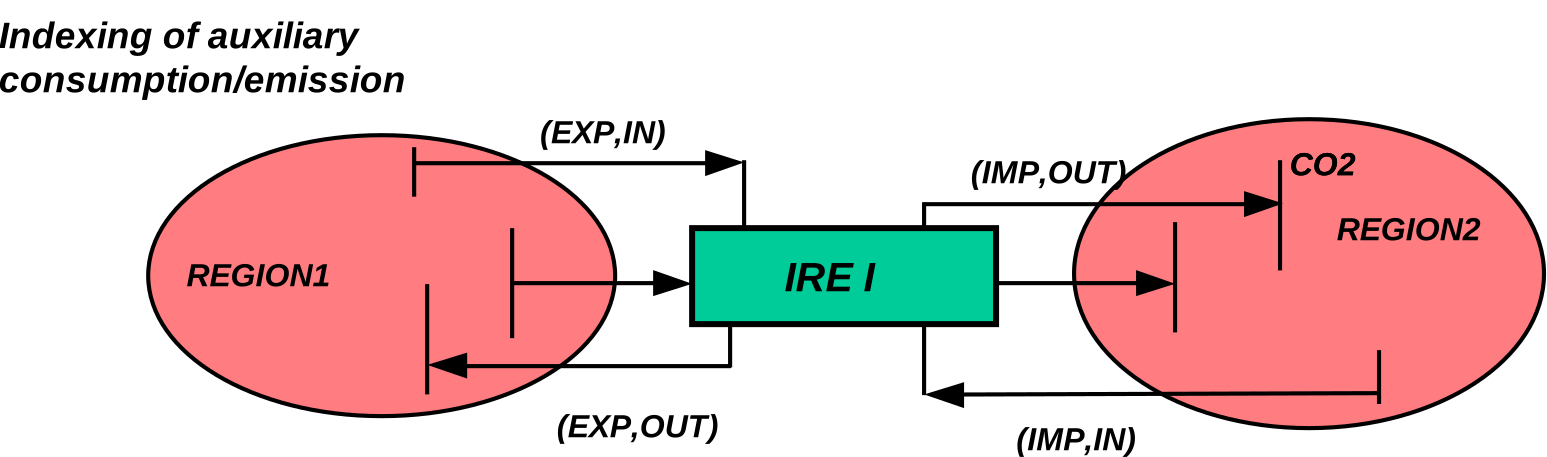
Fig. 3.6 Indexing of auxiliary consumption/emission.
3.2. Internal parameters
Table 3.9 gives an overview of internal parameters generated by the TIMES preprocessor. Similar to the description of the internal sets, not all internal parameters used within TIMES are discussed. The list given in Table 3.9 focuses mainly on the parameters used in the preparation and creation of the equations in Chapter 6. In addition to the internal parameters listed here, the TIMES preprocessor computes additional internal parameters which are either used only as auxiliary parameters being valid only in a short section of the code or which are introduced to improve the performance of the code regarding computational time.
Internal parameter[31] (Indexes) |
Instances (Required / Omit / Special conditions) |
Description |
|---|---|---|
ALPH
|
For learning technologies teg when ETL is used. |
Axis intercept on cumulative cost axis for description of linear equation valid for segment kp. |
BETA
|
For learning technologies teg when ETL is used. |
Slope of cumulative cost curve in segment kp (= specific investment cost). |
CCAPK
|
For learning technologies teg when ETL is used. |
Cumulative capacity at kinkpoint kp. |
CCOST0
|
For learning technologies teg when ETL is used. |
Initial cumulative cost of learning technology teg. |
CCOSTK
|
For learning technologies teg when ETL is used. |
Cumulative investment cost at kinkpoint kp. |
CCOSTM
|
For learning technologies teg when ETL is used. |
Maximum cumulative cost based on CCAPM. |
COEF_AF
|
For each technology, at the level of process operation (PRC_TSL). |
Availability coefficient of the capacity (new investment variable VAR_NCAP plus still existing past investments NCAP_PASTI) in EQ(l)_CAPACT; COEF_AF is derived from the availability input parameters NCAP_AF, NCAP_AFA and NCAP_AFS taking into account any specified MULTI or SHAPE multipliers. |
COEF_CPT
|
For each technology the amount of an investment (VAR_NCAP) available in the period. |
Fraction of capacity built in period v that is available in period t; might be smaller than 1 due to NCAP_ILED in vintage period or the fact that the lifetime ends within a period. |
COEF_ICOM
|
Whenever there is a commodity required during construction, the consuming being taken from the balance constraint (EQ(l)_COMBAL).
|
Coefficient for commodity requirement during construction in period t due to investment decision in period v (see also NCAP_ICOM). |
COEF_OCOM
|
Whenever there is a commodity released during decommissioning, the production being added to the balance constraint (EQ(l)_COMBAL).
|
Coefficient for commodity release during decommissioning time in period t due to investment made in period v. |
COEF_PTRAN
|
For each flow through a process. |
Coefficient of flow variable of commodity c belonging to commodity group cg in EQ_PTRANS equation between the commodity groups cg and com_grp. |
COEF_PVT
|
For each region, the present value of the time in each period. |
Coefficient for the present value of periods, used primarily for undiscounting the solution marginals. |
COEF_RPTI
|
For each technology whose technical life (NCAP_TLIFE) is shorter than the period. |
Number of repeated investment of process p in period v when the technical lifetime minus the construction time is shorter than the period duration; Rounded to the next largest integer number. |
COR_SALVD
|
For each technology existing past the end of the modelling horizon with decommissioning costs, adjustment in the objective function. |
Correction factor for decommissioning costs taking into account technical discount rates and economic decommissioning times. |
COR_SALVI
|
For each process extending past the end of the modelling horizon adjustment in the objective function. |
Correction factor for investment costs taking into account technical discount rates, economic lifetimes and a user-defined discount shift (triggered by the control switch MIDYEAR (see Section 6.2 EQ_OBJ). |
D
|
For each period, D(t) = E(t)–B(t)+1. |
Duration of period t. |
DUR_MAX |
For the model. |
Maximum of NCAP_ILED + NCAP_TLIFE + NCAP_DLAG + NCAP_DLIFE + NCAP_DELIF over all regions, periods and processes. |
LEAD
|
For each milestone year. |
Time between milestone years t–1 and t, in years. For the first milestone year t1, LEAD(t1)=M(t1)–B(t1)+1. |
M
|
For each period, if the duration of the period is even, the middle year of the period is B(t) + D(t)/2 – 1, if the period is uneven, the middle year is B(t) + D(t)/2 – 0.5. |
Middle year of period t. |
MINYR |
For the model |
Minimum year over t = M(t) – D(t) +1; used in objective function. |
MIYR_V1 |
For the model |
First year of model horizon. |
MIYR_VL |
For the model |
Last year of model horizon. |
NTCHTEG
|
For learning technologies teg when ETL with technology clusters is used. |
Number of processes using the same key technology teg. |
OBJ_ACOST
|
For each process with activity costs.
|
Inter-/Extrapolated variable costs (ACT_COST) for activity variable (VAR_ACT) for each year. |
OBJ_COMNT
|
For each commodity with costs, taxes or subsidies on the net production.
|
Inter-/Extrapolated cost, tax and subsidy (distinguished by the type index) on net production of commodity (c) for each year associated with the variable VAR_COMNET. Cost types (type) are COST, TAX and SUB. |
OBJ_COMPD
|
For each commodity with costs, taxes or subsidies on the commodity production.
|
Inter-/Extrapolated cost, tax and subsidy (distinguished by the type index) on production of commodity (c) for each year associated with the variable VAR_COMPRD. Cost types (type) are COST, TAX and SUB. |
OBJ_CRF
|
For each technology with investment costs.
|
Capital recovery factor of investment in technology p in objective function taking into account the economic lifetime (NCAP_ELIFE) and the technology specific discount rate (NCAP_DRATE) or, if the latter is not specified, the general discount rate (G_DRATE). |
OBJ_CRFD
|
For each technology with decommissioning costs.
|
Capital recovery factor of decommissioning costs in technology p taking into account the economic lifetime (NCAP_DELIF) and the technology specific discount rate (NCAP_DRATE) or, if the latter is not specified, the general discount rate (G_DRATE). |
OBJ_DCEOH
|
Enters objective function (EQ_OBJSALV). |
Discount factor for the year EOH + 1 based on the general discount rate (G_DRATE). |
OBJ_DCOST
|
For each technology with decommissioning costs.
|
Inter-/Extrapolated decommissioning costs (NCAP_DCOST) for each year related to the investment (VAR_NCAP) of process p. |
OBJ_DISC
|
Enters objective function (EQ_OBJINV, EQ_OBJVAR, EQ_OBJFIX, EQ_OBJSALV, EQ_OBJELS). |
Annual discount factor based on the general discount rate (G_DRATE) to discount costs in the year y to the base year (G_DYEAR). |
OBJ_DIVI
|
Enters objective function (EQ_OBJINV). |
Divisor for investment costs (period duration, technical lifetime or investment lead time depending on the investment cases 1a, 1b, 2a, 2b). |
OBJ_DIVIII
|
Enters objective function (EQ_OBJINV). |
Divisor for decommissioning costs and salvaging of decommissioning costs (period duration, technical lifetime or decommissioning time depending on the investment cases 1a, 1b, 2a, 2b). |
OBJ_DIVIV
|
Enters objective function (EQ_OBJFIX). |
Divisor for fixed operating and maintenance costs and salvaging of investment costs. |
OBJ_DLAGC
|
Enters objective function (EQ_OBJFIX). |
Inter-/Extrapolated fixed capacity (VAR_NCAP+NCAP_PASTI) costs between the end of the technical lifetime and the beginning of the decommissioning for each year. |
OBJ_FCOST
|
For each flow variable with flow related costs.
|
Inter-/Extrapolated flow costs (FLO_COST) for each year for the flow or trade variable (VAR_FLO, VAR_IRE) as well as capacity related flows (specified by NCAP_COM, NCP_ICOM, NCAP_OCOM). |
OBJ_FDELV
|
For each flow with delivery costs.
|
Inter-/Extrapolated delivery costs (FLO_DELIV) for each year for the flow or trade variable (VAR_FLO, VAR_IRE) as well as capacity related flows (specified by NCAP_COM, NCP_ICOM, NCAP_OCOM). |
OBJ_FOM
|
For each process with fixed operating and maintenance costs.
|
Inter-/Extrapolated fixed operating and maintenance costs (NCAP_FOM) for the installed capacity (VAR_NCAP+NCAP_PASTI) for each year. |
OBJ_FSB
|
For each process with subsidy on existing capacity.
|
Inter-/Extrapolated subsidy (NCAP_FSUB) on installed capacity (VAR_NCAP+NCAP_PASTI) for each year. |
OBJ_FSUB
|
For each flow variable with subsidies.
|
Inter-/Extrapolated subsidy (FLO_SUB) for the flow or trade variable (VAR_FLO, VAR_IRE) for each year as well as capacity related flows (specified by NCAP_COM, NCP_ICOM, NCAP_OCOM). |
OBJ_FTAX
|
For each flow variable with taxes.
|
Inter-/Extrapolated tax (FLO_TAX) for flow or trade variable (VAR_FLO, VAR_IRE) for each year as well as capacity related flows (specified by NCAP_COM, NCP_ICOM, NCAP_OCOM). |
OBJ_FTX
|
For each process with taxes on existing capacity.
|
Inter-/Extrapolated tax (NCAP_FTAX) on installed capacity (VAR_NCAP+NCAP_PASTI) for each year. |
OBJ_ICOST
|
For each process with investment costs.
|
Inter-/Extrapolated investment costs (NCAP_COST) for investment variable (VAR_NCAP) for each year. |
OBJ_IPRIC
|
For each import/export flow with prices assigned to it.
|
Inter-/Extrapolated import/export prices (IRE_PRICE) for import/export variable (VAR_IRE) for each year. |
OBJ_ISUB
|
For each process with subsidy on new investment.
|
Inter-/Extrapolated subsidy (NCAP_ISUB) on new capacity (VAR_NCAP) for each year. |
OBJ_ITAX
|
For each process with taxes on new investment.
|
Inter-/Extrapolated tax (NCAP_ITAX) on new capacity (VAR_NCAP) for each year. |
OBJ_PASTI
|
Enters objective function (EQ_OBJINV). |
Correction factor for past investments. |
OBJ_PVT
|
Used as a multiplier in objective function in a few sparse cases. |
Present value of time (in years) in period t, according to currency cur in region r, discounted to the base year. |
OBJSIC
|
For learning technologies.
|
Investment cost related salvage value of learning technology teg with vintage period v at year EOH+1. |
OBJSSC
|
For processes with investment costs.
|
Investment cost related salvage value of process p with vintage period v at year EOH+1. |
PAT
|
For learning technologies teg when ETL is used. |
Learning curve coefficient in the relationship: SC = PAT * VAR_CCAP^(-PBT). |
PBT
|
For learning technologies teg when ETL is used. |
Learning curve exponent PBT(r,teg) = LOG(PRAT(r,teg))/LOG(2). |
PYR_V1 |
For the model |
Minimum of pastyears and MINYR. |
RS_FR
|
Defined for all commodities. Applied to flow variables in all equations in order to take into account cases where the variables may be defined at a different timeslice level than the level of the equation. |
Fraction of timeslice s in timeslice ts, if s is below ts, otherwise 1. In other words, RS_FR(r,s,ts) = G_YRFR(r,s) / G_YRFR(r,ts), if s is below ts, and otherwise 1. |
RS_STG
|
Mainly applied for the modelling of storace cycles, but also in dispatching equations. |
Lead from previous timeslice in the same cycle under the parent timeslice. |
RS_STGAV
|
Only applicable to storage processes (STG): timeslice storage devices, to calculate activity costs in proportion to the time the commodity is stored. |
Average residence time of storage activity. |
RS_STGPRD
|
Only applicable to storage processes (STG): timeslice storage, inter-period storage or night storage devices. |
Number of storage periods in a year for each timeslice. |
RS_UCS
|
Applied in timeslice-dynamic user constraints, to refer to the previous timeslice in the same cycle. |
Lead from previous timeslice in the same cycle under the parent timeslice. |
RTP_FFCX
|
The efficiency parameter COEF_PTRAN is multiplied by the factor (1+RTP_FFCX).
|
Average SHAPE multiplier of the parameter FLO_FUNC and FLO_SUM efficiencies in the EQ_PTRANS equation in the period (t) for capacity with vintage period (v). The SHAPE curve that should be used is specified by the user parameter FLO_FUNCX. The SHAPE feature allows to alter technical parameter given for the vintage period as a function of the age of the installation. |
RTCS_TSFR
|
Defined for each commodity with COM_FR. Applied to flow variables in all equations in order to take into account cases where some of the variables may be defined at a different timeslice level than the level of the equation. |
The effective handling of timeslice aggregation/disaggregation. If ts is below s in the timeslice tree, the value is 1, if s is below ts the value is COM_FR(r,s) / COM_FR(r,ts) for demand commodities with COM_FR given and G_YRFR(r,s) / G_YRFR(r,ts) for all other commodities.
|
SALV_DEC
|
For those technologies with salvage costs incurred after the model horizon the contribution to the objective function. |
Salvage proportion of decommissioning costs made at period v with commissioning year k. |
SALV_INV
|
For those technologies with salvage costs incurred after the model horizon the contribution to the objective function. |
Salvage proportion of investment made at period v with commissioning year k. |
YEARVAL
|
A value for each year. |
Numerical value of year index (e.g. YEARVAL(‘1984’) equals 1984). |
3.3. Report parameters
3.3.1. Overview of report parameters
The parameters generated internally by TIMES to document the results of a model run are listed in Table 3.10. These parameters can be imported into the VEDA-BE tool for further result analysis. They are converted out of the GDX[32] file via the gdx2veda GAMS utility into a VEDA-BE compatible format according to the file times2veda.vdd[33]. Note that some of the results are not transferred into parameters, but are directly accessed through the times2veda.vdd file (levels of commodity balances and peaking equation, total discounted value of objective function). The following naming conventions apply to the prefixes of the report parameters:
CST_: detailed annual undiscounted cost parameters; note that also the costs of past investments, which are constants in the objective function, are being reported;
\(PAR\_\): various primal and dual solution parameters;
\(EQ(l)\_\): directly accessed GAMS equation levels/marginals
\(REG\_\): regional total cost indicators.
Report parameter[34] (Indexes) |
VEDA-BE attribute name |
Description |
|---|---|---|
AGG_OUT
|
VAR_FOut |
Commodity production by an aggregation process:
|
CAP_NEW
|
Cap_New |
Newly installed capacity and lumpsum investment by vintage and commissioning period:
|
CM_RESULT
|
VAR_Climate |
Climate module results for the levels of climate variable (c) in period (t). |
CM_MAXC_M
|
Dual_Clic |
Climate module results for the duals of constraint related to climate variable (c) in period (t). |
CST_ACTC
|
Cost_Act |
Annual activity costs:
|
CST_COMC
|
Cost_Com |
Annual commodity costs:
|
CST_COME
|
Cost_Els |
Annual elastic demand cost term:
|
CST_COMX
|
Cost_Comx |
Annual commodity taxes/subsidies:
|
CST_DAM
|
Cost_Dam |
Annual damage cost term:
|
CST_DECC
|
Cost_Dec |
Annual decommissioning costs:
|
CST_FIXC
|
Cost_Fom |
Annual fixed operating and maintenance costs:
|
CST_FIXX
|
Cost_Fixx |
Annual fixed taxes/subsidies:
|
CST_FLOC
|
Cost_Flo |
Annual flow costs (including import/export prices):
|
CST_FLOX
|
Cost_Flox |
Annual flow taxes/subsidies:
|
CST_INVC
|
Cost_Inv |
Annual investment costs:
|
CST_INVX
|
Cost_Invx |
Annual investment taxes/subsidies:
|
CST_IREC
|
Cost_ire |
Annual implied costs of endogenous trade:
|
CST_PVC
|
Cost_NPV |
Total discounted costs by commodity (optional, activate by setting RPT_OPT(‘OBJ’,’1’)=1):
|
CST_PVP
|
Cost_NPV |
Total discounted costs by process (optional, activate by setting RPT_OPT(‘OBJ’,’1’)=1):
|
CST_SALV
|
Cost_Salv |
Salvage values of capacities at EOH+1:
|
CST_TIME
|
Time_NPV |
Discounted value of time by period:
|
EQ_PEAK.L
|
EQ_Peak |
Peaking Constraint Slack:
|
EQE_COMBAL.L
|
EQ_Combal |
Commodity Slack/Levels:
|
EQG_COMBAL.L
|
EQ_Combal |
Commodity Slack/Levels:
|
F_IN
|
VAR_FIn |
Commodity Consumption by Process:
|
F_OUT
|
VAR_FOut |
Commodity Production by Process:
|
OBJZ.L
|
ObjZ |
Total discounted system cost:
|
P_OUT
|
VAR_POut |
Commodity Flow Levels by Process (set RPT_OPT(NRG_TYPE,’1’)=1 to activate, see Part III):
|
PAR_ACTL
|
VAR_Act |
Process Activity:
|
PAR_ACTM
|
VAR_ActM |
Process Activity – Marginals:
|
PAR_CAPL
|
VAR_Cap |
Technology Capacity:
|
PAR_CAPLO
|
PAR_CapLO |
Capacity Lower Limit:
|
PAR_CAPM
|
VAR_CapM |
Technology Capacity – Marginals:
|
PAR_CAPUP
|
PAR_CapUP |
Capacity Upper Limit:
|
PAR_COMBALEM
|
EQ_CombalM |
Commodity Slack/Levels – Marginals:
|
PAR_COMBALGM
|
EQ_CombalM |
Commodity Slack/Levels – Marginals:
|
PAR_COMNETL
|
VAR_Comnet |
Commodity Net:
|
PAR_COMNETM
|
VAR_ComnetM |
Commodity Net – Marginal:
|
PAR_COMPRDL
|
VAR_Comprd |
Commodity Total Production:
|
PAR_COMPRDM
|
VAR_ComprdM |
Commodity Total Production – Marginal:
|
PAR_CUMCST
|
VAR_CumCst |
Cumulative costs by type (if constrained);\ Level of cumulative constraint for costs of type (uc_n) and currency (c) in region (r).
|
PAR_CUMFLOL
|
EQ_Cumflo |
Cumulative flow constraint – Levels:
|
PAR_CUMFLOM
|
EQ_CumfloM |
Cumulative flow constraint – Marginals:
|
PAR_EOUT
|
VAR_Eout |
Electricity supply by technology and energy source (optional):
|
PAR_FLO
|
see: F_IN/F_OUT |
Flow of commodity (c) entering or leaving process (p) with vintage period (v) in period (t). |
PAR_FLO
|
none |
Discounted reduced costs of flow variable of commodity (c) in period (t) of process (p) with vintage period (v); the reduced costs describe that the flow variable is at its lower (upper) bound, and give the cost increase (decrease) of the objective function caused by an increase of the lower (upper) bound by one unit; the undiscounted reduced costs can be interpreted as the necessary decrease / increase of the cost coefficient of the flow variable, such that the flow will leave its lower (upper) bound. |
PAR_IRE
|
see: F_IN/F_OUT |
Inter-regional exchange flow of commodity (c) in period (t) via exchange process (p) entering region (r) as import (ie=’IMP’) or leaving region (r) as export (ie=’EXP’). |
PAR_IREM
|
none |
Discounted reduced costs of inter-regional exchange flow variable of commodity (c) in period (t) of exchange process (p) with vintage period (v); the reduced costs describe that the flow variable is at its lower (upper) bound, and give the cost increase (or decrease) of the objective function caused by an increase of the lower (upper bound) by one unit; the undiscounted reduced costs can be interpreted as the necessary decrease / increase of the cost coefficient of the flow variable in the objective function, such that the flow will leave its lower (upper) bound. |
PAR_IPRIC
|
EQ_IreM |
Inter-regional trade equations – Marginals:
|
PAR_NCAPL
|
VAR_Ncap |
Technology Investment – New capacity:
|
PAR_NCAPM
|
VAR_NcapM |
Technology Investment – Marginals:
|
PAR_NCAPR
|
VAR_NcapR |
Technology Investment – BenCost + ObjRange (see Part III, Section 3.10 for more details):
|
PAR_PASTI
|
VAR_Cap |
Technology Capacity:
|
PAR_PEAKM
|
EQ_PeakM |
Peaking Constraint Slack – Marginals:
|
PAR_TOP
|
PAR_Top |
Process topology:
|
PAR_UCMRK
|
User_conFXM |
Marginal cost of market-share constraint:
|
PAR_UCRTP
|
User_DynbM |
Marginal cost of dynamic process bound constraint:
|
PAR_UCSL
|
User_con |
Level of user constraint (or its slack) (only reported when the VAR_UC variables are used):
|
PAR_UCSM
|
User_conFXM |
Marginal cost of user constraint (all bound types):
|
REG_ACOST
|
Reg_ACost |
Regional total annualized costs by period:
|
REG_IREC
|
Reg_irec |
Regional total discounted implied trade cost:
|
REG_OBJ
|
Reg_obj |
Regional total discounted system cost:
|
REG_WOBJ
|
Reg_wobj |
Regional total discounted system cost by component:
|
VAL_FLO
|
Val_Flo |
Annual commodity flow values:
|
3.3.2. Acronyms used in cost reporting parameters
The acronyms used in the reporting parameters for referring to certain types of costs are summarized in Table 3.11. The acronyms are used as qualifiers in the \(uc\_n\) index of each reporting attribute, and are accessible in VEDA-BE through that same dimension.
Cost parameter |
Component acronyms |
|---|---|
CAP_NEW (r,v,p,t,uc_n) |
Newly installed capacity and lump-sum investment costs by vintage and commissioning period:
|
CST_PVC (uc_n,r,c) |
Total discounted costs by commodity (optional):
|
CST_PVP (uc_n,r,p) |
Total discounted costs by process (optional):
|
REG_ACOST (r,t,uc_n) |
Regional total annualized costs by period:
|
REG_WOBJ (r,uc_n,c) |
Regional total discounted system cost by component:
|
3.3.3. The levelized cost reporting option
As indicated in Table 3.10 above, the reporting of levelized costs for each process can be requested by setting the option RPT_OPT(‘NCAP’, ‘1’). The results are stored in the VEDA-BE \(Var\_NcapR\) result attribute, with the qualifier ‘LEVCOST’ (with a possible system label prefix).
The levelized cost calculation option looks to weight all the costs influencing the choice of a technology by TIMES. It takes into consideration investment, operating, fuel, and other costs as a means of comparing the full cost associated with each technology.
Levelized cost can be calculated according to the following general formula:
where
\(r\) = discount rate (e.g. 5%)
\(IC_t\) = investment expenditure in (the beginning of) year \(t\)
\(OC_t\) = fixed operating expenditure in year \(t\)
\(VC_t\) = variable operating expenditure in year \(t\)
\(FC_{it}\) = fuel-specific operating expenditure for fuel \(i\) in year \(t\)
\(FD_{it}\) = fuel-specific acquisition expenditure for fuel \(i\) in year \(t\)
\(ED_{jt}\) = emission-specific allowance expenditure for emission \(j\) in year \(t\) (optional)
\(BD_{kt}\) = revenues from by-product \(k\) in year \(t\) (optional; see below)
\(MO_{mt}\) = output of main product \(m\) in year \(t\)
The exponent \((t-0.5)\) in the formula indicates the good practice of using mid-year discounting for continuous streams of annual expenditures.
In TIMES, the specific investment, fixed and variable O&M costs and fuel-specific flow costs are calculated directly from the input data. However, for the fuel acquisition prices, emission prices and by-product prices, commodity marginals from the model solution are used. All the unit costs are multiplied by the corresponding variable levels as given by the model solution: investment cost and fixed operating costs are multiplied by the amounts of capacity installed / existing, variable operation costs by the activity levels, and fuel-specific costs by the process flow levels. Mid-year discounting can also be activated.
The outputs of the main products are taken from the flow levels of the commodities in the primary group (PG) of the process. An exception is CHP processes, for which the electricity output is considered the sole main output, and heat is considered as a by-product.
Options for variants of levelized cost reporting:
Do not include emission prices or by-product revenues in the calculation (RPT_OPT(‘NCAP’,’1’) = –1):
In this option emission prices are omitted from the calculation, in accordance with the most commonly used convention for LEC calculation. Consequently, any by-product revenues need to be omitted as well, because if emissions have prices, the by-product prices in the solution would of course be polluted by those prices, and thus it would be inconsistent to use them in the calculation. Instead, in this case any amount of by-product energy produced by ELE, CHP and HPL processes is indirectly credited by reducing the fuel-specific costs in the calculation to the fraction of the main output in the total amount of energy produced.
Include both emission prices and by-product revenues in the calculation (RPT_OPT(‘NCAP’,’1’) = 1):
In this option both emission prices and by-product revenues are included in the calculation. The levelized cost thus represents the unit cost after subtracting the levelized value of all by-products from the gross value of the levelized cost. This approach of crediting for by-products in the LEC calculation has been utilized, for example, in the IEA Projected Costs of Generating Electricity studies.
Include not only emission prices and by-product revenues, but also the revenues from the main product in the calculation (RPT_OPT(‘NCAP’,’1’) = 2):
This option is similar to option (2) above, but in this case all product revenues are included in the calculation, including also the peak capacity credit from the TIMES peaking equation (when defined). The calculated LEC value thus represents the levelized net unit cost after subtracting the value of all products from the gross levelized cost. For competitive new capacity vintages, the resulting levelized cost should in this case generally be negative, because investments into technologies that enter the solution are normally profitable. For the marginal technologies the levelized cost can be expected to be very close to zero. Only those technologies that have been in some way forced into the solution, e.g. by specifying lower bounds on the capacity or by some other types of constraints, should normally have a positive levelized cost when using this option.
In the TIMES calculation, the expenditures for technology investments and process commodity flows include also taxes minus subsidies, if such have been specified. The levelized costs are calculated by process vintage, but only for new capacity vintages, as for them both the full cost data influencing technology choice and the operating history starting from the commissioning date are available, which is rarely the case for existing vintages.